Motivation does not come first — action brings it
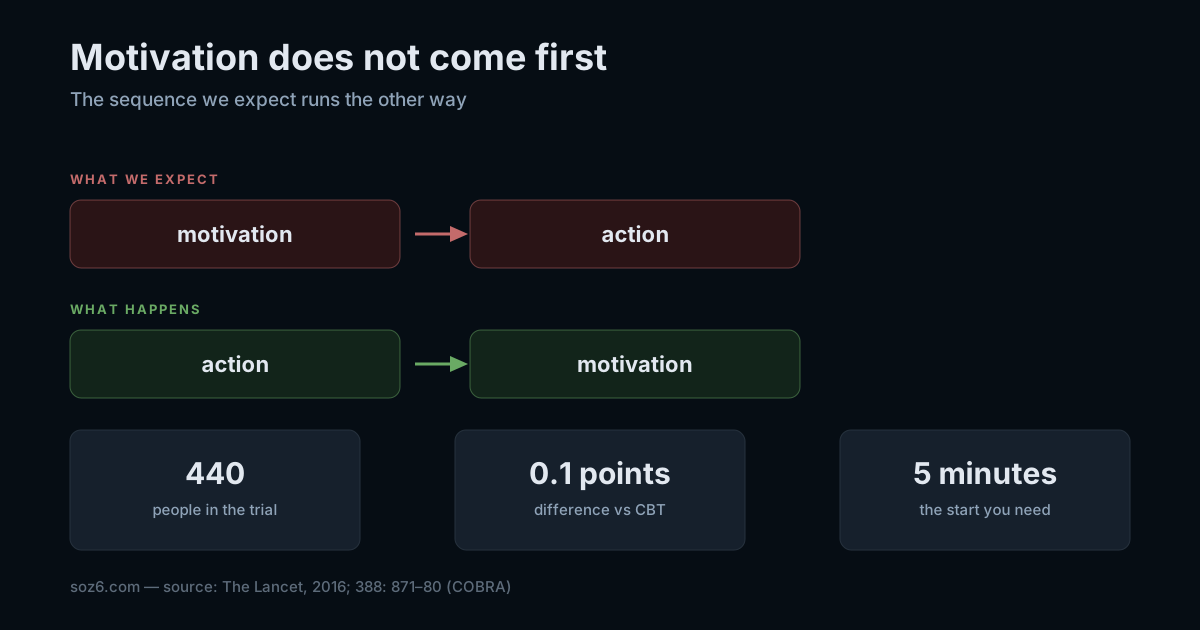
We all wait: let a little motivation arrive, then I'll start. A 440-person trial published in The Lancet suggests the sequence runs the other way. The brain's dopamine system is the chemistry of movement rather than pleasure — and it switches on after you begin.
There is a kind of waiting everyone knows. There is something to do, and no desire to do it. You tell yourself: let me feel a bit better first, then I'll start. I'll do it when I feel like it.
Sometimes the feeling arrives. Often it does not. And the day goes by like that.
Underneath the waiting is a belief: desire first, action second. That you have to feel well in order to do something.
Thirty years of psychology suggest the sequence runs the other way.
The clearest evidence comes from a treatment called behavioural activation. Its principle is almost strangely simple: don't try to fix your thoughts first — put small, meaningful actions back into your life, and do them regardless of how you feel. Go for the walk. Call the friend. Spend five minutes on the unfinished thing. Without checking whether you're in the mood.
In 2016 The Lancet published a large trial of this method. 440 people with depression were split into two groups: 219 received classical cognitive behavioural therapy (CBT), and 221 received behavioural activation. The first was delivered by experienced therapists; the second by junior workers without the long training.
The result: no difference. The average gap between the two groups on the standard scale was 0.1 points — statistically zero. The simple method did not fall behind the complex one, and cost considerably less.
Which means what shifted people's mood was not only the restructuring of thought. Simply starting to do things again works too.
There is a reason in the brain. Dopamine was for a long time called the pleasure chemical. Later work showed that its main job is not enjoying but wanting — seeking, moving toward. Researchers describe it as a split between "wanting" and "liking". Dopamine is the chemistry of anticipation, of progress, of the signal that says keep going.
The practical consequence: the system switches on AFTER the action. When you start, the brain registers progress; progress produces the signal; the signal produces the desire to continue. Motivation is not waiting for you at the door. It comes up behind you once you are inside.
This is also the cruellest mechanism in depression. A person withdraws, the world narrows, and in a narrowed world the odds of anything good happening fall — which makes withdrawing look correct. The loop feeds itself. Behavioural activation breaks it from the outside, at the level of the step rather than the thought: it changes the door, not the idea.
The advice that falls out of this can sound trite, but it is precise: make the beginning absurdly small. Not the book — one page. Not the workout — put the shoes on. Not the article — one sentence. The goal is not to finish; it is to start the system. You can decide again in five minutes.
One thing said plainly: this is not "pull yourself together". Behavioural activation is a clinical treatment, not a test of willpower. Severe depression is a real illness, and no article replaces professional help — including this one. If you have been unable to climb out for a long time, what you need is a doctor, not this text.
But for ordinary, non-severe days — the "I don't feel like anything today" days — there is something genuinely useful here.
You do not have to wait until you feel ready. Readiness is not the condition for starting. It is the result of it.