A volcano exploded, and two years later the world had Frankenstein and the bicycle
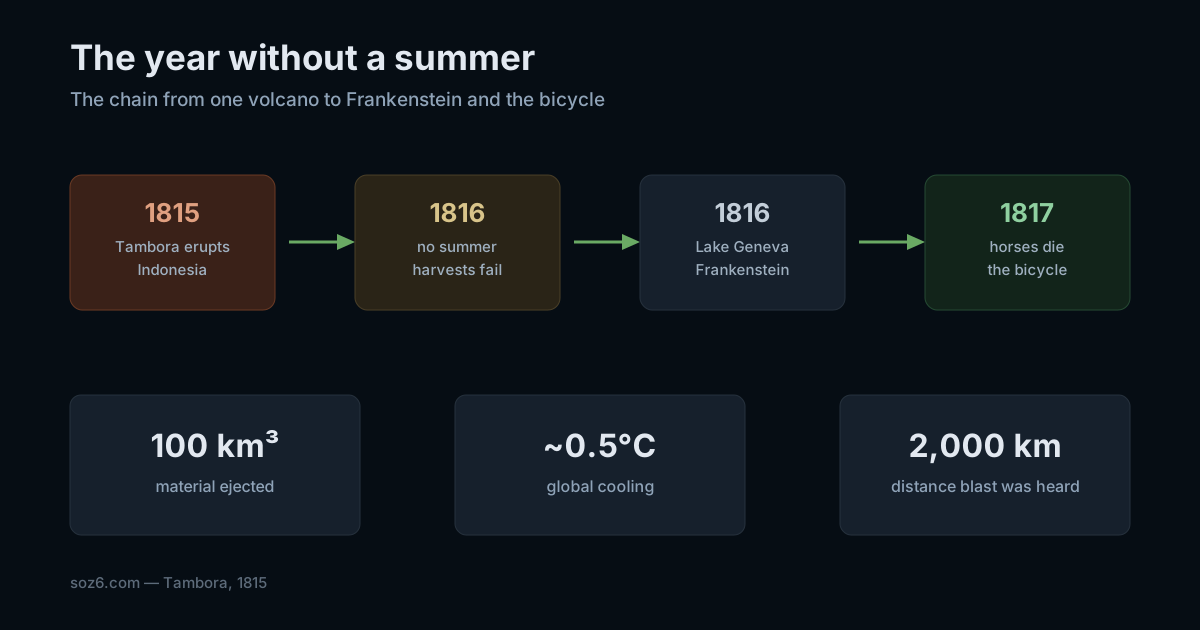
In 1815 Mount Tambora erupted in Indonesia. In 1816 Europe and America had no summer — snow in June, failed harvests, horses starving. In that rainy summer Mary Shelley wrote *Frankenstein*, and a German baron looking for a way to travel without a horse invented the bicycle.
In June 1816 it snowed in New England. In July the lakes iced over. In August a frost killed what little grain was left. Americans later gave that year a name: "Eighteen Hundred and Froze to Death."
That summer produced two things. One is the most famous monster in world literature. The other is the bicycle. Both came out of a volcano.
In April 1815, Mount Tambora erupted on the island of Sumbawa in Indonesia. It is the most powerful volcanic eruption in recorded history. The mountain threw roughly 100 cubic kilometres of material into the atmosphere and lost about 1,200 metres of its own height doing it. The blast was heard two thousand kilometres away — far enough that some garrisons mistook it for cannon fire and prepared for battle.
Ash falls quickly. The ash was not the problem; the sulphur was. The eruption lifted millions of tonnes of sulphur gas into the stratosphere, where it turned into fine droplets and drew a thin, invisible mirror around the planet. That mirror sent part of the sunlight back.
The result was about half a degree of cooling. Half a degree sounds like nothing. But half a degree is enough to shave the edges off the growing season across the entire northern hemisphere.
In Europe the harvest simply failed. 1816 and 1817 are recorded as the worst famine of the nineteenth century. Bread prices multiplied in Switzerland, Germany and France; in Ireland it rained for twelve straight weeks and typhus followed. In China and India the monsoon broke.
Now look at two consequences of that summer.
First. In June 1816 a group of English travellers had rented a villa on Lake Geneva. The rain kept them indoors for weeks. Out of boredom, Lord Byron proposed that each of them write a ghost story. One of the party was an eighteen-year-old named Mary Shelley. What she wrote became *Frankenstein*. Another guest, the physician John Polidori, wrote *The Vampyre* — the first text of the modern vampire. A large part of gothic horror was born in one volcano's rainy summer.
Second, and stranger. A famine does not only strike people. Oats — horse feed — were among the first things to disappear. Horses across Europe starved, and many were slaughtered for meat. And the horse was the only transport of the age.
In Germany a baron named Karl von Drais looked at this and asked a simple question: how could a person travel without needing an animal at all? In June 1817 he rode a two-wheeled machine with no pedals, pushed along by foot. They called it the Laufmaschine. That is the ancestor of the bicycle.
So the chain runs like this: a mountain explodes in Indonesia; a year later the grain fails in Europe; the horses die; and a baron goes looking for a way to travel on wheels. There are roughly a billion bicycles in the world today.
The strangest part is that nobody at the time knew why any of it was happening.
The people living through 1816 could not explain why they were freezing. They blamed sunspots. Some argued that Benjamin Franklin's lightning rods had disturbed the air. Most took it for divine punishment. There was no network on earth that could connect an explosion in Indonesia to snow in Vermont ten thousand kilometres away. The link was only established in the twentieth century, when volcanic ash was read out of ice cores.
That is the real part of the story. The cause was a year earlier and half a planet away — and it was invisible. If the same eruption happened today there would be satellite images, sulphur measurements and a forecast within hours. The difference is not in the volcano. The difference is that we can see it.
A mountain explodes and a girl writes a novel about a monster. That is how the world works — we are just very late in noticing the connections.