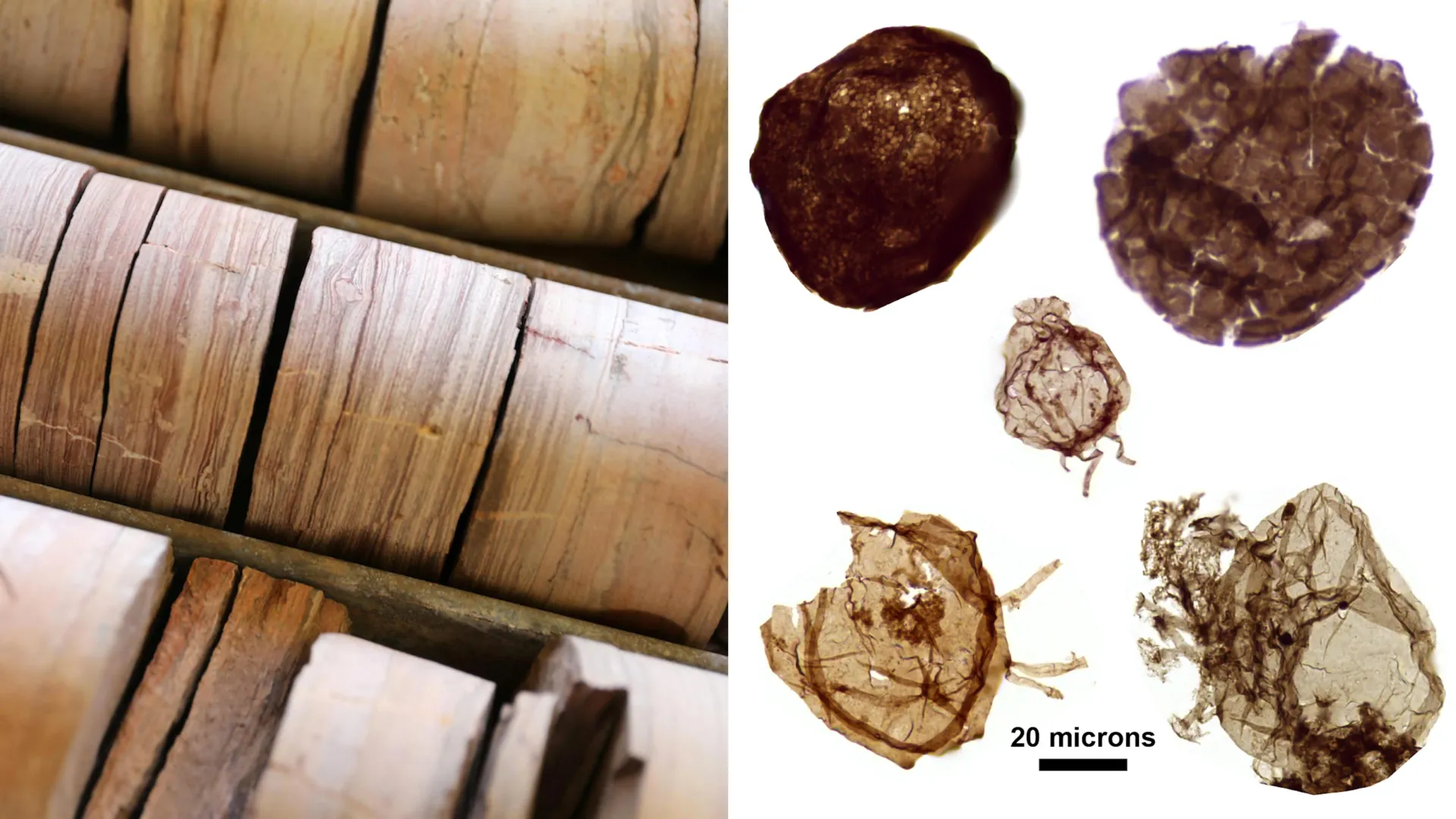
Stored in an open-air warehouse in tropical Darwin, Australia, are dozens of trays containing cylindrical cores of rock. They are from drill holes bored hundreds of metres below the surface by mineral exploration companies decades ago. Some of these cores at the Northern Territory Geological Survey are mudstone – a type of sedimentary rock formed from hardened seafloor mud.
The companies that drilled these cores were largely unaware that within these mudstones were fossils of microscopic organisms buried on the seafloor of an ancient inland sea that covered much of northern Australia over 1.5 billion years ago. As our new study, published in Nature, shows, these fossils are crucial for addressing a longstanding puzzle about the major evolutionary leap that led to all complex life on Earth: the origin of eukaryotes. All life on Earth can be placed into one of two types which are fundamentally different at the cellular level.
Prokaryotes (bacteria and archaea) have simple cellular organization and are mostly single celled. Eukaryotes – including all animals, plants, algae and fungi – are very different. They have much more complicated cells featuring a nucleus and other specialized structures such as organelles which perform specific jobs.
The eukaryotic revolution transformed the planet. It led to the rise of animals and, eventually, to us. Based on observations from the genes of living organisms, it is now widely agreed that the last common ancestor of all living eukaryotes resulted from the symbiotic union of (at least) two prokaryotic microbes: an archaeon and a bacterium.
The first evidence for eukaryotic life comes in the form of these fossils of single-celled organisms. They show a level of cellular complexity not seen among prokaryotes, but common in eukaryotes. Eukaryote fossils can be found around the world in rocks dating back at least 1.5 billion years.
The fossils of the Northern Territory, the oldest of which date back to 1.75 billion years ago, are the oldest currently known eukaryote fossils globally. But the ancient world in which early eukaryotes evolved remains shrouded in mystery. And so many fundamental aspects regarding their nature are unknown.
Extract — continue reading at the source.