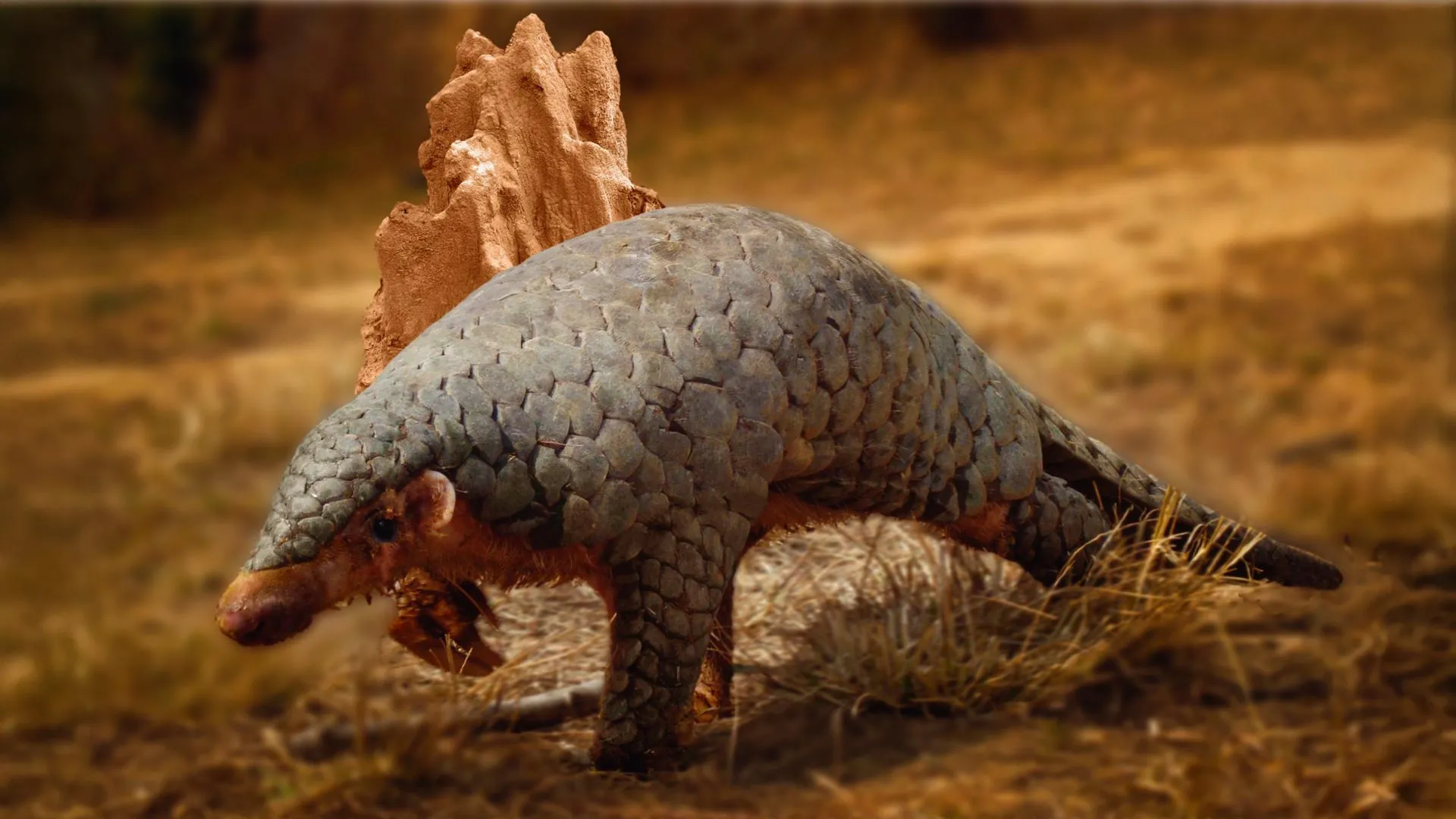
These medium-sized mammals, found only in Africa and Asia, have long, powerful tails, large curved claws, and bodies covered in overlapping scales that resemble a pinecone. Those distinctive scales are also a major reason pangolins are in danger. They are heavily targeted by poachers and are considered the most highly trafficked mammals in the world, leaving many species at serious risk of extinction.
Now, researchers have confirmed that a previously unrecognized Asian pangolin species, Manis aurita, has been living in Nepal and Northern India. The findings, published in Communications Biology, clarify how different pangolin species are related, where they live, and how they can be distinguished. That information could also help authorities identify where illegally traded pangolins are being hunted and strengthen efforts to stop poaching.
"We can't protect what we do not know, and now that we have confirmed that this other species of pangolin exists, we can use that information to help protect these endangered animals," says Anderson Feijó, the Negaunee Assistant Curator of Mammals at the Field Museum and co-corresponding author of the study. "This finding marks the culmination of more than five years of research that began in Nepal, where we first documented evidence suggesting that Himalayan pangolins represented a distinct evolutionary lineage," says Narayan Koju, a researcher at the Nepal Engineering College at Pokhara University and the study's first author. "The confirmation of Manis aurita as a valid species demonstrates the importance of long-term research, international collaboration, and museum collections.
Most importantly, it provides a strong scientific basis for conservation planning, wildlife forensics, and efforts to protect one of the world's most trafficked mammals from extinction." The classification of these Himalayan pangolins had already begun to change in 2025. That year, another research team determined that animals previously grouped together as Chinese pangolins actually represented two species. One occurs mainly in China, while the other inhabits the Himalayan foothills across parts of Nepal, India, Bhutan, and Myanmar.
The researchers named the mountain-dwelling form Manis indoburmanica, or the Indo-Burmese pangolin. But scientific naming follows a rule of priority: when the same species has been given more than one scientific name, the earliest valid name takes precedence. At the time, Feijó and his colleagues were already conducting a decade-long investigation into pangolin evolution.
Their work combined DNA evidence with physical characteristics to determine how many pangolin species exist and how those species are related. During that research, they encountered records of Manis aurita, a pangolin described in 1836. Over time, M. aurita had been reclassified as a subspecies of the Chinese pangolin.
Extract — continue reading at the source.