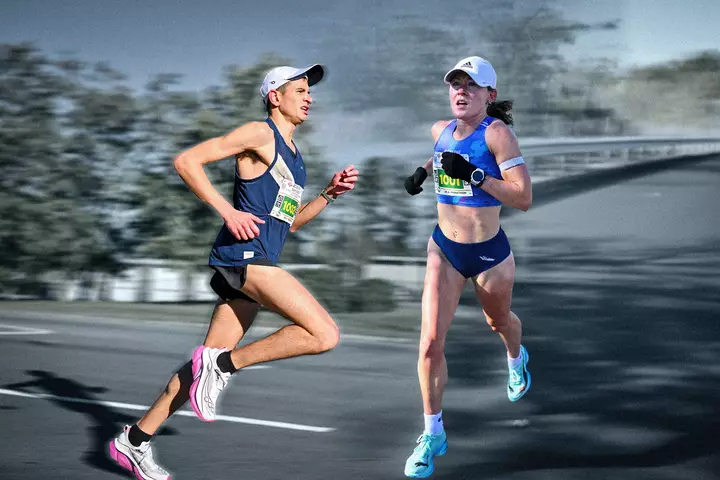
Spencer Friske broke the tape at the Baystate Marathon on October 18 in 2:15:04, winning by more than five minutes and bettering the 2:16 time he needed to qualify for his second Olympic Marathon Trials. Or so it appeared, in the hours immediately after the race. Now it looks like the time won’t count toward the Trials.
Although the course for the Baystate Marathon, in Lowell, Massachusetts, was USATF-certified, the event was not USATF-sanctioned. And that distinction will mean both Friske and women’s winner Caitlin McGinley, who thought she had qualified with her 2:36:08 (the women’s standard is 2:37) after narrowly missing last year at the same race, will likely have to try again if they want to make it to St. Louis in 2028 for the Olympic Marathon Trials.
Friske and McGinley separately declined interview requests from Runner’s World the day after the race except to say they were thankful to the Baystate Marathon for “putting on a great race.” On race day, Friske, 32, who lives in Boston, told the Lowell Sun he was aiming for the Trials time and knew he was close. On her Strava after the race, before she learned of the snafu with the race’s credentials, she wrote, “For years, this was a dream I was almost too afraid to let myself envision. Today, I finally got to live it.” In USATF’s database of sanctioned events, the Baystate Marathon is shown as having a sanction from 2017 to 2020, but not since then.
It is unclear how Annie Heffernan, who qualified for the 2024 Trials at the Baystate Marathon in 2023, was eligible to run. Olympic Team Trials - Marathon qualification standards state that an event must be sanctioned by USATF or another World Athletics member federation to count toward a qualifying time. Sanctioning demonstrates an event’s commitment to applicable competition rules, athlete and spectator safety, and appropriate event management.
We have made best efforts to communicate this to race directors and Trials hopefuls. However, we need to increase these efforts and will be doing so in the coming days as we want to ensure everyone is aware. We do not want to see people’s hard work and accomplishments end in disappointment.” On its website, USATF sets out the rules for qualifying for the Olympic Marathon Trials.
The third item on the list is that the qualifying race must be sanctioned. Sanctioning “signifies adherence to national and international rules, commitment to safety, and proper management of event operations,” USATF says. The fee for sanctioning for a race of Baystate’s size, 2,385 finishers in 2026 across the marathon and half marathon, would be roughly $2,000, or less than $1 per finisher, depending on whether the race used USATF insurance or its own.
Extract — continue reading at the source.