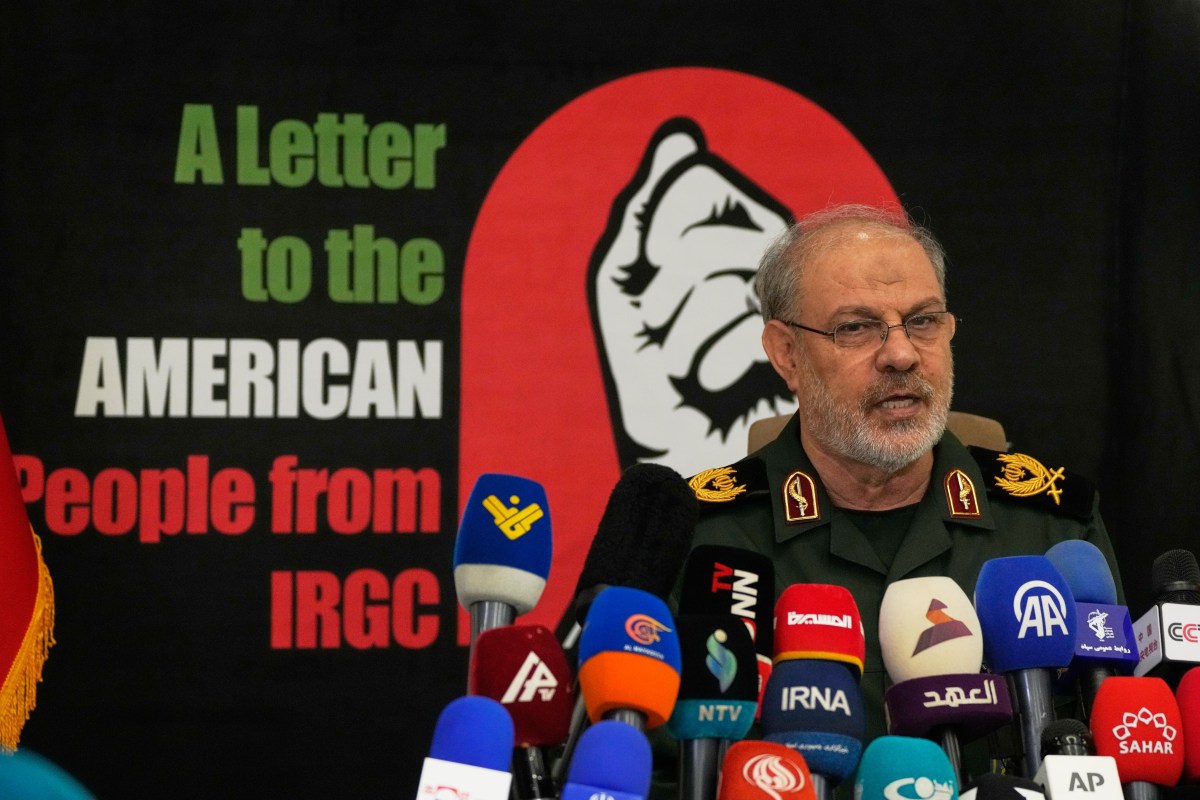
Iran's Islamic Revolutionary Guard Corps (IRGC) has issued an open letter to the people of the United States in which Tehran declares victory in its confrontation with Washington, lodges sweeping allegations against President Donald Trump and warns of more dire consequences should the current U.S. government remain in power. The 25-page message comes at a sensitive time for the White House, with midterm elections soon approaching and diminishing domestic support for the war launched against the Islamic Republic in February. The IRGC frequently channeled U.S. voter frustrations in the letter, going so far as to urge U.S. citizens to rise up against their government.
The call to action marks one of several points in which the elite Iranian military branch appears to use language mirroring Trump's own rhetoric against the Islamic Republic. While the degree to which U.S. citizens or officials may be moved by the lengthy dispatch is uncertain, the unprecedented decision by the IRGC to speak past government channels indicates a serious attempt to seize the narrative over the war and its global ramifications. "We wrote a benevolent and compassionate letter to the American people," IRGC spokesperson Brigadier General Hossein Mohebbi was cited as saying Tuesday by official outlets.
"Our goal in sending the letter to the American people goes beyond media publicity and fostering familiarity with Iran's logic," Mohebbi said. "This action is not a promotional and short-term move." Trump may have declared the U.S. the winner of the conflict with Iran on many past occasions, but the IRGC sees itself as the true victor. That's due to the U.S. and Israel, which jointly entered the conflict with the Trump administration, "failing to achieve" their objectives, including the initial alleged goals of "regime change and partition of Iran" and a subsequent list of 13 other identified aims, including the invasion and seizure of Iranian territories, the total destruction of military and civilian energy infrastructure "The United States and Israel expended thousands of bombs and missiles, striking government and residential buildings, dozens of less advanced and lower-tier weapons-manufacturing facilities, and a number of decommissioned military installations," the IRGC said.
"Yet, aside from damaging several buildings tied to Iran’s nuclear industry and a limited number of air-defense sites, they failed to achieve any of their declared objectives." "Now, nearly seven months into this unjust war, the U.S. military—the largest and costliest military in the history of the world—has scored no wins, and that is all the more humiliating when we consider that it fought the war in collaboration with the Israeli military, which claims to be the world’s fourth-largest military power," the IRGC added. The IRGC's "concrete evidence" for its win was not limited to denying enemy objectives, however. The letter also counted the extensive damage dealt by Iranian missile and drone attacks to U.S. bases and military equipment across the Middle East as well as a swell of support at home and abroad for the Islamic Republic, among other reasons, as proof of Iranian victory and a resounding U.S. defeat.
"Arguably, however, the greatest consequence of this war has been the damage it has done to America’s reputation as the world’s sole superpower and the irreparable and gaping cracks it has created in the edifice of U.S. global hegemony," the IRGC said. "The U.S. can no longer boast of its status as the world’s hegemon." Another factor cited by the IRGC as contributing to Washington's declared loss in the conflict was the Islamic Republic's religious zeal. The IRGC may be a military institution, operating alongside the Iran's conventional armed forces, known as the Artesh, but it occupies a dual role in safeguarding the tenets of the 1979 Islamic Revolution that established the unique wilayat al-faqih (or velayat-e faqih) system of governance.
This interpretation of Twelver Shiite Islam affords absolute power to a "guardian jurist" to preside over the state as supreme leader, a role held by Ayatollah Mojtaba Khamenei since shortly after his father's killing on the first day of U.S.-Israeli strikes that began the conflict. "Though painful, the martyrdom of Iran’s Supreme Leader did not lead, as American and Israeli politicians had hoped, to the disintegration of the Islamic Republic, and this was a testament to the resilience of a political system rooted in the will of the people," the IRGC said. And while "the United States and Israel possess more powerful and more advanced missiles and drones, plus a variety of other forms of weaponry that Iran lacks," the IRGC asserted that Iran's victory was rooted in the "Quran’s superior doctrine and worldview," "the competent and righteous leadership of a man of God and "the Iranian nation’s faith in and unity around the tenets of the Quran." On the other hand, the IRGC argued that U.S. military is "comprised of forces suffer from low morale and lack a strong sense of purpose and is led by arrogant commanders who are blinded by a complacent sense of self-assurance stemming from their confidence in their vast arsenal and abundant resources." "The main problem afflicting the U.S. military is that its forces have no clear idea why they are asked over and over to fight for causes that are utterly meaningless and irrelevant to them," the IRGC said.
Extract — continue reading at the source.