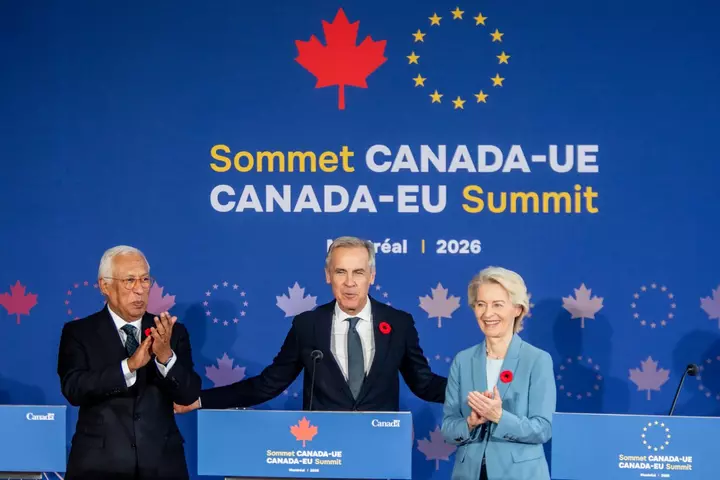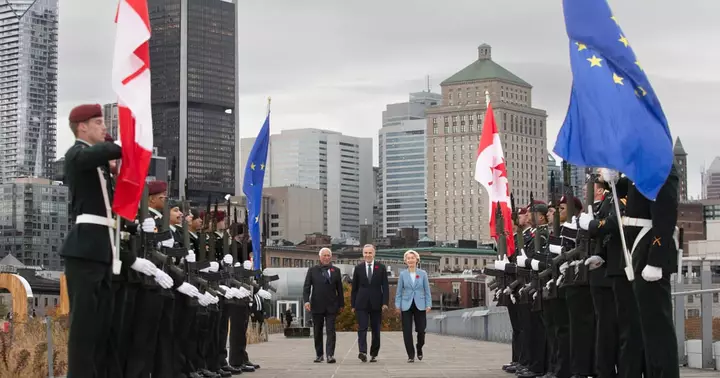
MONTREAL — Prime Minister Mark Carney wanted the landmark EU-Canada summit to be about much more than “nomenclature.” He got what he craved. Over a whirlwind 48 hours in Montreal, top officials from Brussels and Ottawa huddled to pursue agreements on critical minerals, super computers and defense cooperation. European Commission President Ursula von der Leyen, European Council President António Costa and Carney gathered as U.S.
President Donald Trump continues to upend the global order and Chinese dominance of critical markets squeezes middle powers. Those challenges have pushed the EU and Canada into a rapidly developing partnership that eclipses anything attempted by Brussels with a non-member country since the bloc was formed. Here are all the key things POLITICO learned during the EU-Canada meetings.
Initially reluctant, the Canadian prime minister came around by the end of the summit to endorse von der Leyen’s controversial label for the global alliance the EU and Canada are building. Carney set a six-month deadline to firm up the ground rules of what “associate membership” is, trialing an induction process that could be a model for other non-European countries. Carney added he will meet periodically with von der Leyen to track progress, including a return trip for the College of European Commissioners to meet with their Canadian counterparts in March.
Both Canadian and EU officials are walking away from the summit with at least one major win: the framework agreement signed between the European Investment Bank and Canada that will open up the bloc’s lending arm to Canadian critical minerals crucial for future tech. That means batteries, circuit boards and semiconductors, which all require lithium, nickel, cobalt and other critical raw materials that, as of now, the EU is largely dependent on China to score. The deal helps wean the Europeans off a politically volatile critical minerals dealer, for a more reliable Canadian supplier.
The agreement does not immediately unlock funding for specific projects, but it supports pathways for future investments in Canadian mining and helps link the bloc’s supply chains with Canada’s. Critical minerals aren’t the only Canadian natural resource on the menu for Europeans. Carney has said he wants to make Canada an “energy superpower” and leverage huge stores of oil and liquefied natural gas in his country for export.
The only problem: Most of it is in the western province of Alberta, far from Europe. But the summit concluded with a commitment by both sides to a “long-term feasibility study” on exporting LNG to Europe via the east coast or Arctic ports closer to the bloc. Peter Welch (D-Vt.) was there doing damage control.
Extract — continue reading at the source.