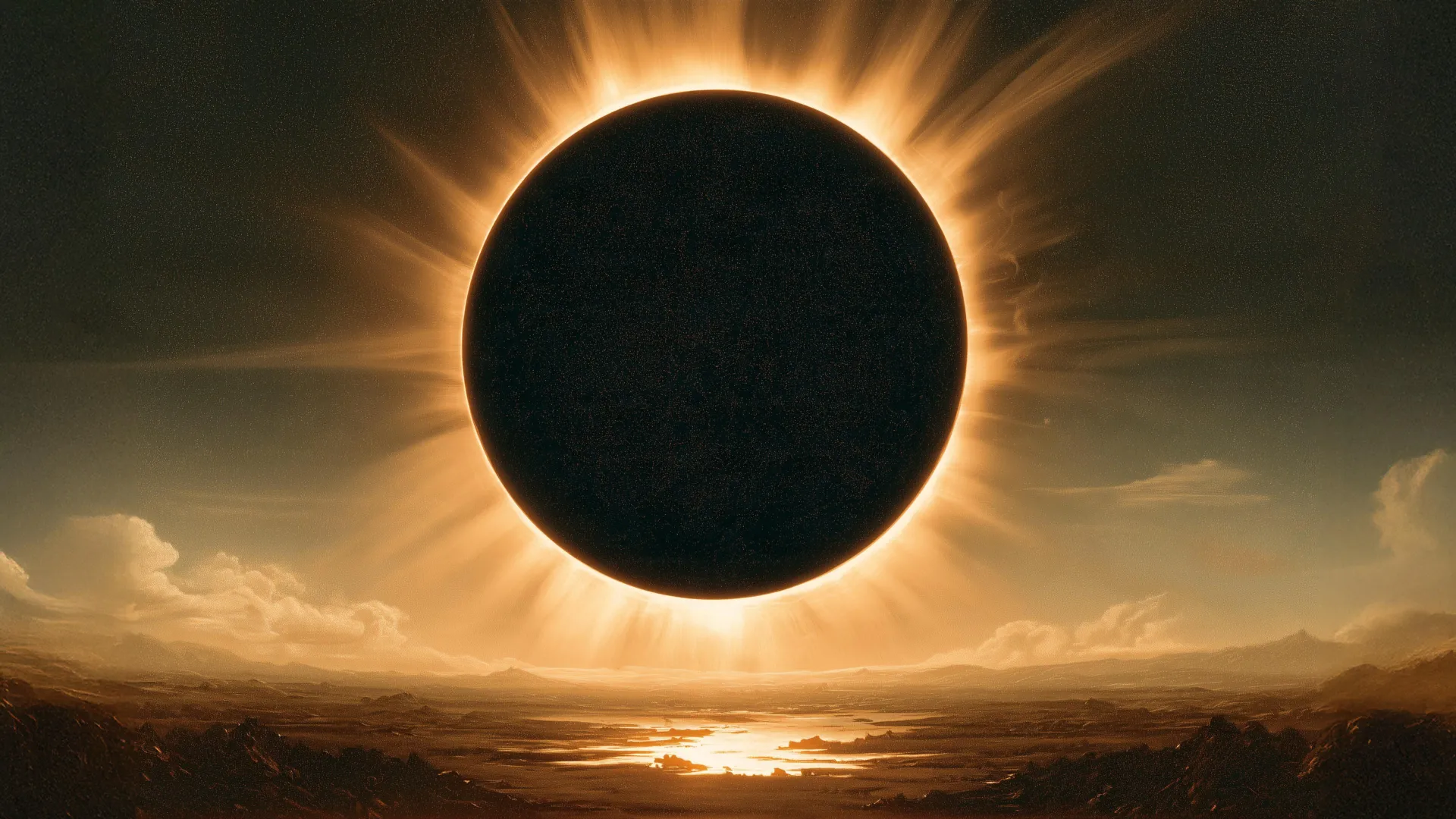
An international research team has revisited one of the oldest precisely dated records of a total solar eclipse, uncovering new details about how Earth's rotation has changed over thousands of years. By combining historical geography with modern astronomical calculations, the scientists reconstructed an eclipse that occurred in 709 BCE and determined how it would have appeared from Qufu, the ancient capital of China's Lu Duchy. The researchers also examined an early account that may describe the solar corona, the Sun's faint outer atmosphere that becomes visible to the naked eye during a total solar eclipse.
Their analysis of its possible shape suggests that the Sun was returning to a more active phase following an extended period of unusually low activity. Published in Astrophysical Journal Letters, the findings provide more precise evidence of Earth's rotation speed in ancient times. They also offer potential independent support for previous reconstructions of solar activity based on radiocarbon measurements.
An Ancient Chinese Eclipse Record Holds a Crucial Clue On July 17, 709 BCE, observers at the court of the Lu Duchy witnessed a total solar eclipse. The event was preserved in the "Spring and Autumn Annals," a historical chronicle compiled approximately 200 to 300 years later. The original account stated that "the Sun was totally eclipsed." An additional description appears in the "Hanshu" (Book of Han), which preserves a passage written about seven centuries after the eclipse.
This later account contains an unusual observation that may refer to the Sun's corona. "What makes this record special isn't just its age, but also a later addendum in the 'Hanshu' (Book of Han) based on a quote written seven centuries after the eclipse. It describes the eclipsed Sun as 'completely yellow above and below.' This addendum has been traditionally associated with a record of a solar corona.
If this is truly the case, it represents one of the earliest surviving written descriptions of the solar corona," explained lead author Hisashi Hayakawa, an assistant professor at Nagoya University's Institute for Space-Earth Environmental Research and Institute for Advanced Research. Initially, however, the historical account appeared to conflict with modern astronomy. When the team calculated the eclipse's path using existing estimates of Earth's ancient rotation, their results indicated that a total eclipse should not have been visible from the previously assumed location of the Lu court in Qufu.
The researchers traced the discrepancy to a mistake in the city's geographic coordinates. By examining archaeological excavation reports and historical geographic evidence, they determined that earlier calculations had placed ancient Qufu approximately eight kilometers from its actual location. Correcting this relatively small error made it possible to reconstruct the eclipse more accurately and extract valuable information about Earth's rotation and the Sun's appearance.
Extract — continue reading at the source.


