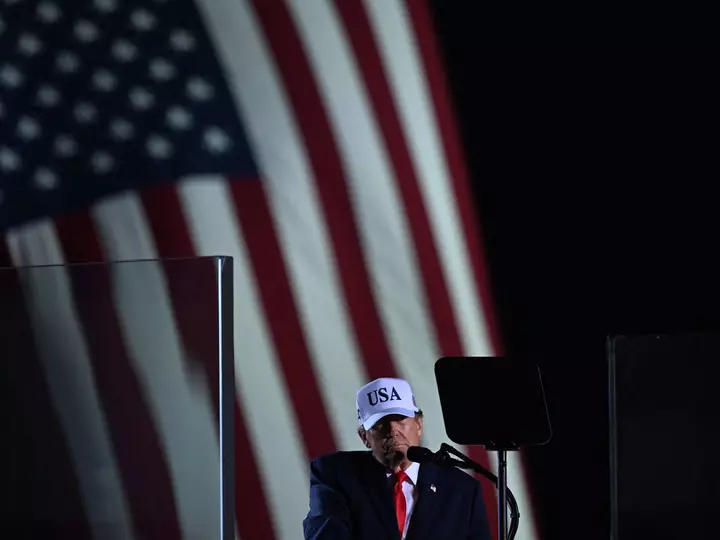
President Donald Trump wants a three-way summit with his Russian and Chinese counterparts when the three men are in Shenzhen next month for an economic forum. In the worst scenario, Trump and Xi Jinping would conspire to doom Ukraine to Vladimir Putin’s subjugation. In the best, however, they would open a long and necessary process toward an eventual nuclear detente among the U.S., Russia and China.
Trump claims he wants this trilateral meeting “not so much for Ukraine” but “to talk about nuclear weapons and denuclearization.” Let’s take him at his word. What would such talks look like? And what lesson could Trump take from a West German chancellor in the 1970s?
At least three developments — even aside from new dangers such as artificial intelligence entering the nuclear command chains — make trilateral nuclear talks urgent. First, since the expiration this year of the last arms-control treaty between the U.S. and Russia, no formal limits constrain the nine nuclear powers at all. Second, whereas arms control used to be a (relatively) simple matter between the two atomic superpowers — Russia and the U.S. still account for 86% of all nukes — it is now a much more complicated “three-body problem” because China is fast catching up.
And the U.S. must assume that Moscow and Beijing could one day gang up against Washington. And third, today’s arms race isn’t only about the number of nukes but also about the types of warheads, delivery vehicles and war plans that are emerging. China and Russia are increasingly investing in “tactical” weapons.
Those are designed not to destroy the homeland of the main adversary (the U.S., in their case) but to win, with allegedly “limited” strikes, a conventional war in a local theater, such as the Taiwan Strait or Eastern Europe. Tactical nukes are considered especially dangerous precisely because they appear more usable but could still cause uncontrolled escalation to Armageddon. That’s why the U.S. after the Cold War mothballed almost all its tactical warheads (except for about 100 that are stationed at allied bases in Europe).
Moscow retired fewer of its tactical nukes, and it now outnumbers the U.S. about 10-to-1 in that category. Worse, Putin has repeatedly threatened to use such weapons in Ukraine. And China has been adding tactical nukes to signal to the U.S. that it cannot be blackmailed or defeated in a regional conflict over Taiwan.
Extract — continue reading at the source.