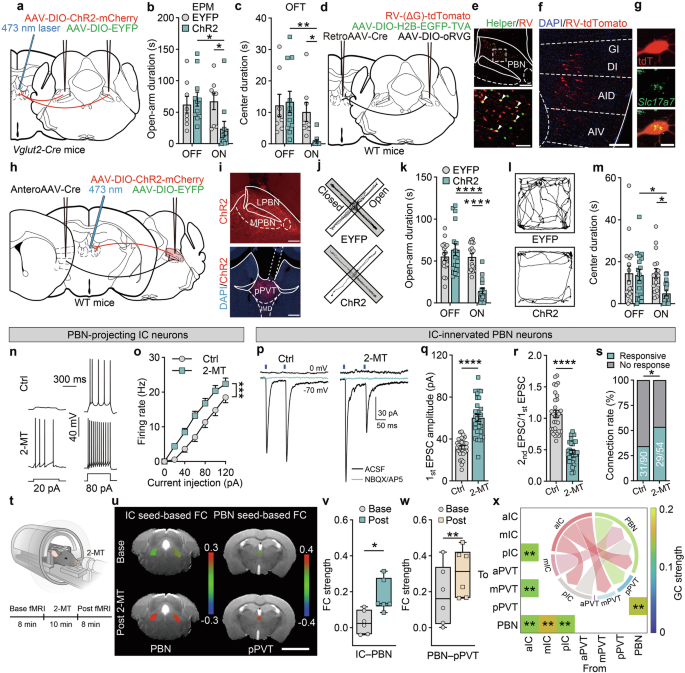
Anxiety disorders are among the most prevalent and debilitating psychiatric conditions, yet the neural circuits underlying anxiety-related states remain incompletely understood. Here we identify a cortical–brainstem–thalamic pathway in which Crh-expressing neurons in the anterior and middle insular cortex (a/mIC) engage the parabrachial nucleus (PBN), which in turn recruits the posterior paraventricular thalamic nucleus (pPVT) to contribute to anxiety-related behavior. Single-cell calcium imaging reveals that the predator odorant 2-methyl-2-thiazoline (2-MT) and footshock recruit partially overlapping populations of PBN-projecting a/mIC neurons; neurons activated by both stimuli exhibit increased activity during open-arm approach in the elevated plus maze.
Exposure to 2-MT increases corticotropin-releasing factor (CRF) signals in the PBN, where CRF enhances PBN neuronal excitability and CRF receptor 1 (CRFR1) signaling facilitates a/mIC-terminal-evoked firing. Inhibition of Crh⁺ a/mIC–PBN projections, Crh knockdown in the a/mIC, or blockade of CRFR1 signaling within the PBN attenuates 2-MT-induced anxiety-like behavior. Human neuroimaging further reveals stronger functional coupling within a putative homologous aIC–PBN–pPVT network in individuals with anxiety symptoms, and the strength of this coupling correlates with anxiety severity.
Together, these findings define a molecularly specified insular circuit that contributes to anxiety-related behavioral states. This is a preview of subscription content, access via your institution Receive 12 print issues and online access Prices may be subject to local taxes which are calculated during checkout All data supporting the findings of this study have been deposited in the Mendeley Data repository (DOI:10.17632/n9zcbt3n26.). The raw single-cell RNA-sequencing data are available in the NCBI Gene Expression Omnibus (GEO) database under accession number GSE345247.
Lancet. 2016;388:3048–59. Van Dis EAM, Van Veen SC, Hagenaars MA, Batelaan NM, Bockting CLH, Van Den Heuvel RM, et al. Long-term outcomes of cognitive behavioral therapy for anxiety-related disorders: a systematic review and meta-analysis.
JAMA Psychiatry. 2020;77:265–73. Article PubMed PubMed Central Google Scholar Slee A, Nazareth I, Bondaronek P, Liu Y, Cheng Z, Freemantle N. Pharmacological treatments for generalised anxiety disorder: a systematic review and network meta-analysis.
Malezieux M, Klein AS, Gogolla N. Neural circuits for emotion. Annu Rev Neurosci. 2023;46:211–31.
Extract — continue reading at the source.