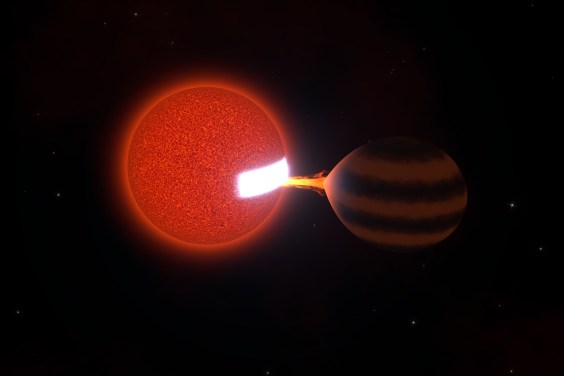
Planets and stars usually have one of two kinds of relationship: Either a planet orbits its star in a fixed and stable circuit, or it flies too close to the sun (literally) and gets consumed by stellar wind and fire. But now, for the first time, astronomers have directly observed an in-between state, a red dwarf star that’s absorbing material from a nearby brown dwarf, but very, very slowly. The transfer of material (or “accretion”) is happening at such a leisurely rate, it might be billions of years before the brown dwarf disappears altogether.
Read more: “This Spectacular Star Field Hides Brown Dwarfs That Never Ignite” Brown dwarfs are themselves in between two states. They’re larger than planets and smaller than stars, and are thus often considered “failed” stars that began to form but never properly ignited. This particular one is within the Milky Way, around 300 light-years from Earth, in a system that’s been named ZTF J0440+2325.
The star itself is relatively small, around 85 times the mass of Jupiter, while the brown dwarf is around 25 times the mass of Jupiter. The latter is orbiting the former every 87 minutes, which gives you an idea of how close they are. But here, we’ve found an alternative: Instead of swallowing the thing up, the star can gradually eat it, for billions of years.” The first sign of this system came in a puzzling reading captured by experts: a triangular light signal that wouldn’t normally be given off by a star.
It turns out the peak of that triangle was the fireball created by the star sucking in the brown dwarf, as it rotated in and out of view of a telescope at the Palomar Observatory in California. It took several years to figure what was happening. The astronomers say the brown dwarf is dumping the equivalent of about 40 million dump trucks’ worth of material into its star every single second.
That’s a lot, but also, we’re talking about an object with 85 times the mass of Jupiter. Now that we know what one of these slow-feeding systems looks like, the hope is that more can be discovered. And with potentially billions of years of snacking time involved, we should have plenty of time to find them.
Subscribe to our free newsletter.
Extract — continue reading at the source.

/https://tf-cmsv2-smithsonianmag-media.s3.amazonaws.com/filer_public/d7/52/d7528f88-21dd-4d21-bb1e-044d2e53a1d6/flu-shot.jpg)