Beneath the seventeenth-century Palace of Westminster there was a hidden Medieval undercroft, enduring like a line of erased poetry not fully obscured as new verse was written over it. The undercroft was some 77-feet long, 24-feet wide, and 10-feet tall: perfect dimensions in which to hide 36 barrels of gunpowder. Had all that mixed sulfur, charcoal, and saltpeter been ignited when King James I opened Parliament on November 5th, 1605, it would have completely obliterated the hodgepodge of Medieval and Tudor buildings where the kingdom conducted its business, killing not just the monarch but over five-hundred parliamentarians, bishops, and judges as well.
Although this regicidal plot had thirteen conspirators, recusant Catholics who thought that toppling James’ government would lead to greater emancipation for their persecuted coreligionists, it’s Guy Fawkes who is most associated with the plan. Oft-quipped as being the only man with honest intentions to enter Parliament, Fawkes was discovered in the late hours the night before the attack was scheduled. Agents of the king found the auburn-haired soldier illuminated by an iron lantern, waiting patiently in the damp basement with a box of matches.
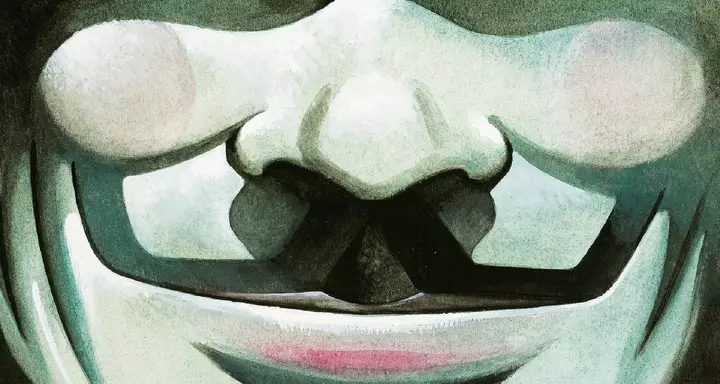
In the centuries after, the sectarian zealot Guy Fawkes would be figured as a boogeyman, burned in effigy every year at anti-Catholic “Guy Fawkes Day” celebrations. Today, however, he’s become an unlikely subversive icon. Comics author Alan Moore and illustrator David Lloyd, followed later by the film producers Lana and Lilly Wachowski, have resurrected a stylized mask of Guy Fawks, with rosy cheeks and black eyes, marked with his distinctive Van Dyke beard and a wide-brimmed hat, as the 21st century’s preeminent symbol against totalitarianism.
The Guy Fawkes mask has become a signifier for opposition to not just injustice or inequity, but against the pervasive, and not unfounded, feeling that we’re all speed-running towards dystopia. V for Vendetta, both in Moore’s comic and the Wachowskis’ film, is the science fiction tale of a vigilante battling a futuristic dystopian government in Britain. In both versions, Fawkes finally gets his intended target.
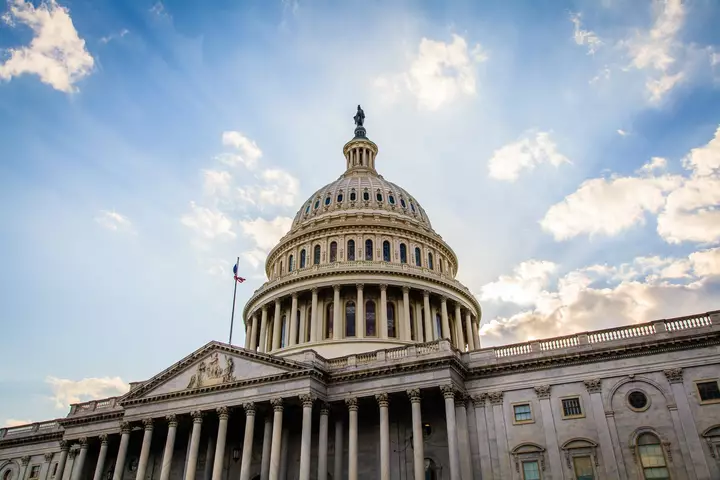
The Neo-Gothic edifice of the Houses of Parliament are destroyed in a cacophony of righteous fire, the clock face of Big Ben shattering as Tchaikovsky’s “The 1812 Overture” thunders over loudspeakers. That Fawkes would attain such a status is odd. The monarchy he rebelled against was certainly authoritarian.
But the intention of the Gunpowder Plot wasn’t to topple theocracy so much as it was to replace the Protestant variety with a Catholic iteration. Nonetheless, as Lewis Call argues in Anarchist Studies, Guy Fawkes has become “liberated from all permanent meaning,” the mask of his bearded, harlequin face now a “potent instrument for the promotion of postmodern anarchism.” The mask is now associated with the hacker collective Anonymous and the #Occupy movement, the Arab Spring, and pro-democracy protests in countries as varied as Turkey and Thailand. Banned in Saudia Arabia and Bahrain, just as the film V for Vendetta was banned in Russia as “LGBT propaganda,” the Guy Fawkes mask has become a signifier for opposition to not just injustice or inequity, but against the pervasive, and not unfounded, feeling that we’re all speed-running towards dystopia.
Extract — continue reading at the source.