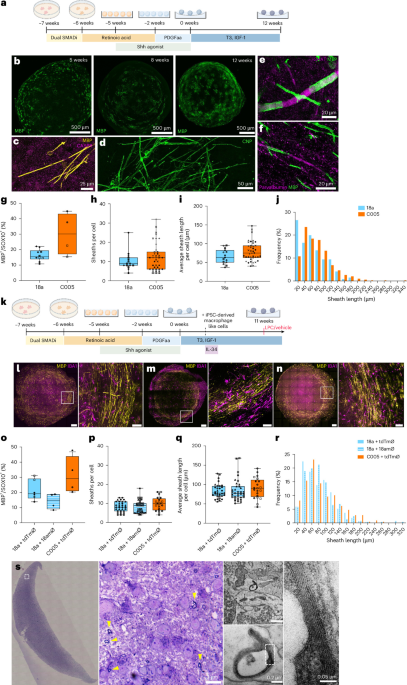
There are no currently approved therapies that promote new myelin formation after myelin damage, which can, in part, be attributed to a lack of reliable systems that can reproducibly model these processes. Here we engineered a human iPSC-derived spheroid model enriched with mature, myelinating oligodendrocytes and functionally reactive microglia. This model enables the study of human central nervous system remyelination after a demyelinating insult by recapitulating processes of myelin damage and repair.
These include myelin fragmentation, microglial reactivity and phagocytosis of myelin debris, oligodendrocyte generation and differentiation, and axonal ensheathment with newly formed myelin. We show that newly generated oligodendrocytes contribute to remyelination, and use ultrastructural quantification to demonstrate that remyelinated axons are ensheathed by thinner myelin after injury. Altogether, we provide a model to interrogate otherwise inaccessible aspects of human myelin biology relevant to multiple sclerosis, providing mechanistic insights into disease pathways and a platform for drug screening.
Axons in the central nervous system (CNS) are ensheathed by myelin, a specialized lipid membrane, that is generated by oligodendrocytes. Both myelin and oligodendrocytes can be destroyed in CNS injury, which can lead to debilitating functional deficits and irreversible neurodegeneration. Fortunately, the CNS has some capacity to generate new myelin as part of a repair process called remyelination.
At present, we can only study these dynamic processes of remyelination in animal models. Although conserved molecular mechanisms have been identified between human myelin biology and that of nonhuman animal models1, distinctions in cell behaviors are evident2. This highlights the pressing need for improved and human-relevant model systems that enable biological insight into human myelin biology.
An improved understanding of these processes may enable identification of pathways that can be therapeutically targeted to promote new myelin formation, which is of the utmost relevance to diseases involving myelin damage, like multiple sclerosis (MS). Using an induced pluripotent stem cell (iPSC)-derived system, we aimed to generate spheroids that model human myelin damage and repair to establish a platform that provides mechanistic insight into these processes and can potentially be used for identifying therapies that successfully promote oligodendrocyte regeneration and myelin repair. We successfully engineered spinal cord-patterned spheroids seeded with separately generated iPSC-derived macrophage cells; upon prolonged culture, these immune cells differentiated into microglia.
After lysolecithin (LPC) exposure, demyelination was observed in the spheroids, evidenced by extensive myelin fragmentation and reduced colocalization of myelin basic protein (MBP)+ myelin with neurofilament-heavy chain (NF-h)+ axons, compared to vehicle-treated spheroids. The microglia increased the antigen presentation marker HLA-DR and, by 7 days after LPC, there was significant colocalization of MBP+ debris within IBA1+ microglia, suggestive of phagocytosis. Four weeks after LPC, there was a significant increase in newly generated oligodendrocytes and, by 8 weeks, these new oligodendrocytes were myelinating, albeit the myelin was thinner than in vehicle-treated controls.
Extract — continue reading at the source.


