Generative artificial intelligence (GenAI) is rapidly becoming a pervasive technology across education, work, research, and everyday life. Yet growing evidence suggests that fluent, coherent, and seemingly transparent AI assistance can improve task performance while weakening the metacognitive engagement and deeper processing required for durable learning. This tension raises a central question about how does offloading to AI reshape human learning, and under what conditions do performance and learning decouple?
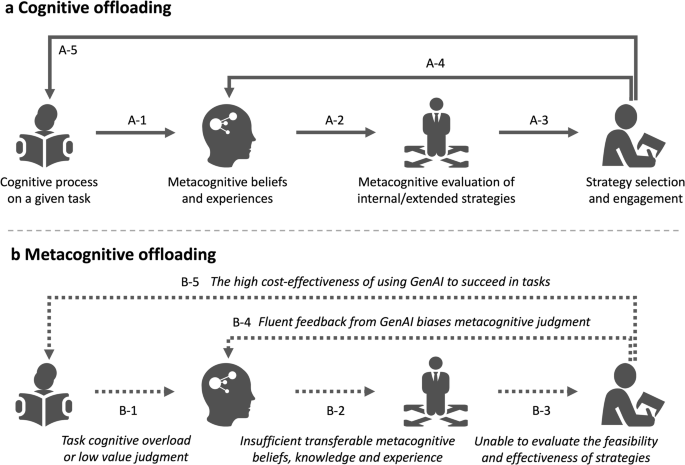
In this Perspective, we introduce the Synergetic Notion of Human-AI Skills and Knowledge Construction (SYNC) model. The model offers a metacognitive account of human-AI interaction by conceptualising metacognitive offloading and metacognitive onloading. The SYNC model aims to explain how human-AI interaction unfolds across learning and performance dimensions, clarifying how learners may drift into overreliant AI-supported performance or move toward human-AI synergy.
We further identify key pitfalls in ineffective human-AI interaction and outline strategies to address them through metacognitive onloading and support human-AI synergy. In human history, each major shift in how people produce, communicate and govern across the agrarian, industrial, and information eras has re-specified the mechanisms of human learning and performance1,2,3,4,5,6,7,8,9. Against this long arc, the rise of artificial intelligence (AI), especially generative AI (GenAI) that can produce text, code, images and analysis on demand, marks another inflexion point10,11.
This inflexion point raises a central question for psychology, education, and technology about how should durable human learning be cultivated so that humans can perform effectively alongside AI technology? The use of GenAI has already begun to reshape how knowledge and skills are formed, practised, and assessed12,13. Large language models (LLMs) can scale personalised tutoring, diversify resources, provide timely formative feedback, and enable conversational, authentic assessments14,15,16,17.
Used well, these capabilities hold the promise to expand access and allow learners to work within their zone of proximal development18,19. When GenAI provides high-quality interventions, personalised examples and scaffolded support rather than simply completing tasks for learners, it can enhance humans’ skill development20,21,22. Yet the same technology is imperfect.
LLMs hallucinate and inherit biases from the training data23,24,25,26. The development and use of LLMs raise privacy and fairness concerns10, may widen digital divides27, and destabilise traditional assessments of human learning by blurring authorship and effort12,28. These ambivalent effects are documented across various learning contexts and motivate a shift from merely using AI tools to deliberately cultivating the human skills necessary to use them effectively10,29.
Extract — continue reading at the source.