The Shakespearean canon contains the term “love juice” twice, both in A Midsummer Night’s Dream. So, though purists might be furious, that druggy usage – and Fairie King Oberon’s access to potions that “make eyes roll” – offer textual justification for Justin Audibert and Hannah Joss staging the play around a narcotic, orgiastic woodland party in the summer of 1994. At that time, prime minister John Major was introducing legislation to ban “illegal raves”.
Egeus (Henry Everett), an Athenian courtier in the source, becomes Chief Constable of West Sussex, surnamed Anderton, an allusion to Sir James, a Thatcher ally whose Bible-inspired policing saw him called God’s Copper. Duke Theseus becomes MP for Chichester, a seat held by the Conservatives for a century from 1924. With one character wearing Major rosettes on her breasts, a PM often derided as dull is becoming a theatre star: the National next year stages a James Graham bio-drama, Major.
High-concept Shakespeare risks bits not fitting, a jeopardy increased in A Midsummer Night’s Dream by a plot divided between courtiers, artisans and faeries. But, in this version, the substances consumed by the first two groups may lead them to hallucinate the third: reports of a woman snogging a donkey or Technicolor creatures filling forests can be attributed to the pharmacopeia of Oberon (David Sturzaker), here a DJ running a rave-based cult. While it’s unclear if he and his followers are from a higher sphere or merely high, the conceit, with word changes and some new speeches, accommodates most of the narrative.
A hard part of the play to sell to modern audiences is the “law of Athens”, by which a woman who refuses her father’s choice of husband must opt for death or the convent. But this religious misogyny seems plausible enough amid the moral hardening in the 90s Tory party that led to three Labour terms and Conservatives defecting further right. Lysander becoming Lysanda (Ellie Larkin), adding bisexuality to the youthful romantic quadrangle, increases the moral jeopardy at this Tory court.
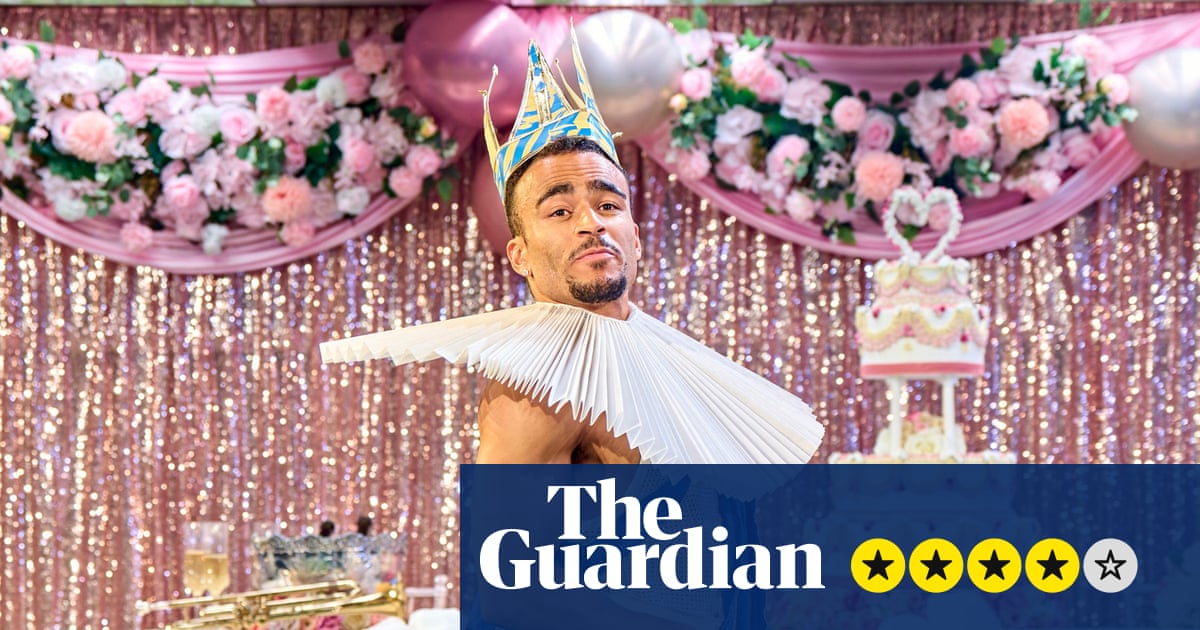
The “rude mechanicals”, who have taken over the local Tory party’s am dram group, are the new working-class Tories of the era, including Nick Bottom, a video shop owner, bewitchingly played, in his full theatrical debut, by comedian Munya Chawawa. He is verbally (“prologue” mispronounced prow-log-wee) and physically energetic: his slapstick gymnastics in the often lumberingly unfunny Pyramus and Thisbe playlet stop the show with earned applause. Female characters are given additional agency, sometimes violent.
Kieran Taylor-Ford’s swaggering Demetrius is regularly doubled over in pain after being thumped in the crotch by Hermia or Helena, potentially interchangeable characters who Angela Sant’Albano and Freya Parks make vividly distinct. Hippolyta (Celeste Dodwell) keeps guys in line with a riding crop. A play that can become tedious through repertoire regularity is lovingly juiced up by Audibert and Joss with resonances local and national.
Extract — continue reading at the source.


