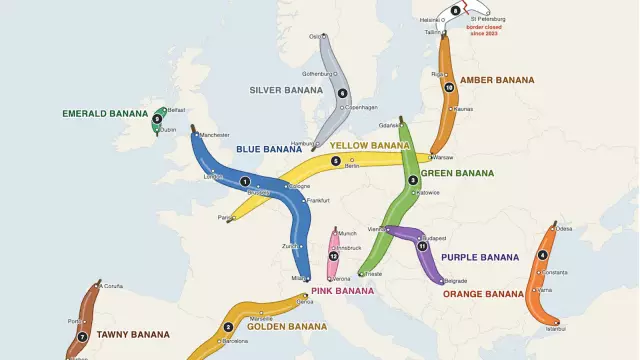
our Twitter (X) feedView our Youtube channelView our Instagram feedView our Substack feedView our Spotify feed If the European Union is serious about integration, it should get silly about names. The Blue Banana is just the biggest and bestknown of the bunch; Europe hides 11 other transnational bananas. nd SocietyEconomic DevelopmentSocial CohesionIdentity Formation Underneath the political map of Europe’s nation-states simmers another reality: a tangle of economic and logistical corridors that transcend national borders. The best known of these is the Blue Banana.
Many others aren’t as visible, and that is due to poor marketing: They lack an equally imaginative handle. Hence this modest proposal: If the European Union is serious about integration, it should get silly about names. All 12 of its major transnational economic corridors should be named after the bendy fruit.
In other words, Europe should go full bananas. The Blue Banana — the first of the bunch, so to speak — is of surprisingly recent vintage. First proposed in 1989 by French geographer Roger Brunet as an economic zone with common characteristics, this urban-industrial belt runs from Manchester in northern England to Milan in northern Italy.
A French minister remarked that Brunet’s area looked a bit like a banana, an illustrator for _Le Nouvel Observateur_ colored it blue, and hey presto, the Blue Banana was born. That nickname did what mere economic stats can’t: It captured the imagination, thus highlighting a process that earlier maps had missed. In an increasingly borderless Europe, the logics of proximity and compatibility are creating zones of economic contiguity across multiple countries.
Roger Brunet’s original map of what he called “the European backbone” (“la dorsale européenne”), later more memorably rebranded “the Blue Banana.” l’espace européen_(1989), cited in _Cahiers de santé publique_ It may lack a flag, an anthem, and a parliament, but the Blue Banana has a cartographic shape, an economic weight, and — thanks to a bendy fruit and a French magazine illustrator — a catchy name. They grab and focus attention — and attract investment. That is why some of Europe’s other international zones of economic similarity thought it useful to adopt the banana idea (see the Green, Yellow, Orange, and Golden Bananas).
But many others haven’t, and Europe should do better than that half-hearted, haphazard approach. It’s sad to see economic corridors of consequence laboring under inauspicious names like STRING, which is something you lose in a drawer, or outright ominous ones like the Atlantic Axis, which sounds like a pact with a dictator that you probably shouldn’t have signed. Giving this whole group of regions a coordinated set of catchy names would not only increase their visibility but also help their inhabitants identify with them.
Extract — continue reading at the source.