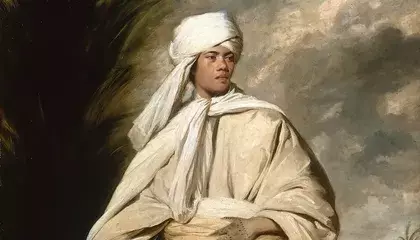
More than 250 years ago, a young Pacific Islander named Mai made a splash when he arrived in England. He became “a sensation, a star of the press, the darling of the intelligentsia [and] the subject of poems, books, musical plays,” as Hampton Sides wrote in an adapted Smithsonian magazine excerpt of The Exotic: Intrigue and Cultural Ruin in the Age of Imperialism. Joshua Reynolds, a leading portraitist of the day, immortalized Mai’s visit in a massive portrait measuring nearly eight feet tall.
Now, for the first time, the painting has made its way across the Atlantic. It’s on view now at the Museum in Los Angeles, giving art aficionados in America a chance to witness one of Britain’s most significant early portraits of a person of color. Mai, also known as Ma‘i or Omai, was a Polynesian man from the island of Raiatea in the South Pacific.
After a childhood of hardship, Mai decided to join British explorer James Cook’s second Pacific expedition, aboard the HMS Adventure—a companion ship to the HMS Resolution—under Captain Tobias Furneaux. After the two ships became separated in a storm in October 1773, Furneaux opted to return to England. When the Adventure sailed into Portsmouth on July 14, 1774, Mai became the first Polynesian to visit Britain.
Joseph Banks, a botanist who had accompanied Cook on his first voyage, became Mai’s patron and chaperone. Over the next two years, Mai became a celebrity of sorts, visiting aristocratic estates, attending concerts and dinner parties, riding horses, hunting and exploring the English countryside. Many Britons assumed he was a Polynesian royal—a misconception Mai did little to correct.
Reynolds is believed to have painted Mai sometime around 1776. He “modeled Mai on ancient Roman senators and military leaders, dressing him in robes reminiscent of Tahitian tapa cloth but with a Roman flair,” Saar Shahar, an English scholar at the University of Southern California, writes for the Conversation. Reynolds depicted the young man barefoot, with a white turban atop his head and intricate tattoos covering his hands.
Mai departed England in 1776 aboard the Resolution and settled on the South Pacific island of Huahine, where he is believed to have died of a virus just a few years later. The artist evidently loved the portrait so much that he kept it in his studio until he died. From there, it passed into the hands of Frederick Howard, 5th Earl of Carlisle, whose family held onto it for roughly 200 years.
Extract — continue reading at the source.
/https://tf-cmsv2-smithsonianmag-media.s3.amazonaws.com/filer_public/e2/80/e280bb3c-f373-4402-8f66-90bc36d20fa8/sherlock-holmes.png)