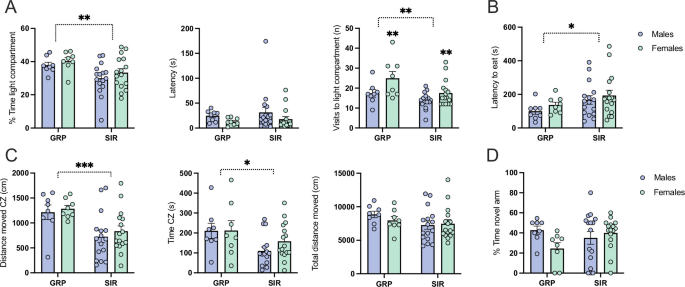
Antenatal depression affects up to 20% of pregnancies worldwide and is associated with increased neuropsychiatric vulnerability in offspring, yet the enduring behavioural, neuroanatomical, and molecular features associated with maternal mood disturbance remain incompletely characterized. To model depression that begins before conception, female mice were subjected to social-isolation rearing (SIR) from weaning through gestation and lactation, and behavioural, neuroanatomical, and molecular outcomes were assessed in adult offspring of both sexes. Offspring of SIR dams exhibited robust anxiety-like behaviours across multiple paradigms.
High-resolution ex vivo structural magnetic resonance imaging revealed reduced relative volumes of the thalamus and striatum, together with relative expansion of gustatory/visceral and visual cortices. Multivariate analyses identified a pattern of thalamostriatal and other regional volume differences that covaried with behavioural impairment. Diffusion tensor imaging further identified region-specific elevations in fractional anisotropy, consistent with persistent differences in brain microstructure.
Transcriptomic profiling of the thalamus revealed widespread, sex-dependent differences in gene expression, implicating pathways related to synaptic organization, protein synthesis, neuronal plasticity, and myelination. Exploratory DNA-methylation analyses identified nominal, sex-dependent pathway enrichments that did not survive false-discovery-rate correction. Together, these findings show that maternal stress beginning before pregnancy leaves a persistent imprint on offspring brain structure, microstructure, and epigenetic regulation, converging on the thalamus as a central hub of intergenerational vulnerability.
This work establishes SIR as a translationally relevant model of depression that predates conception and provides integrated MRI- and molecular-level biomarkers for dissecting mechanisms and informing early preventive strategies. Major depressive episodes during pregnancy affect roughly one in every five expectant mothers worldwide, a prevalence that has risen in the wake of the COVID-19 pandemic [1,2,3,4]. Besides the well-documented emotional burden, untreated maternal depression doubles the risk of pre-term birth, low birth-weight and intra-uterine growth-restriction [5, 6], and is a leading antecedent of maternal suicide—the first-ranked cause of indirect obstetric mortality in high-income nations [7].
Elucidating the biological pathways that link maternal mood to foetal neurodevelopment is therefore a public-health priority. Magnetic-resonance imaging (MRI) has started to reveal how in-utero exposure to maternal mood disturbance shapes the early human brain. Newborns and young infants of depressed mothers show enlarged composite subcortical volumes together with smaller mid-brain structures [8], while diffusion MRI indicates accelerated white-matter maturation in anterior cingulate pathways during the first months of life [9].
A synthesis of eight structural and diffusion-tensor imaging (DTI) MRI studies encompassing ≈1,300 offspring scanned from birth through to middle childhood further shows that higher maternal-depression scores, especially when recorded in the second trimester, associate with thinner right frontal and temporal cortices [10,11,12], fronto-limbic white-matter disorganisation [10], and amygdala volumetric or connectivity alterations [13,14,15,16]; some of these effects tend to be stronger in girls and are amplified when maternal symptoms persist after delivery [10, 15]. These findings suggest that prenatal mood disturbances lead to differential neurodevelopment trajectories, although their long-term anatomical sequelae remain poorly understood. A limited number of longitudinal cohort studies have begun to track young-adult brains after prenatal stress or depression exposure, almost exclusively led by Marečková and colleagues [17,18,19,20].
Extract — continue reading at the source.


