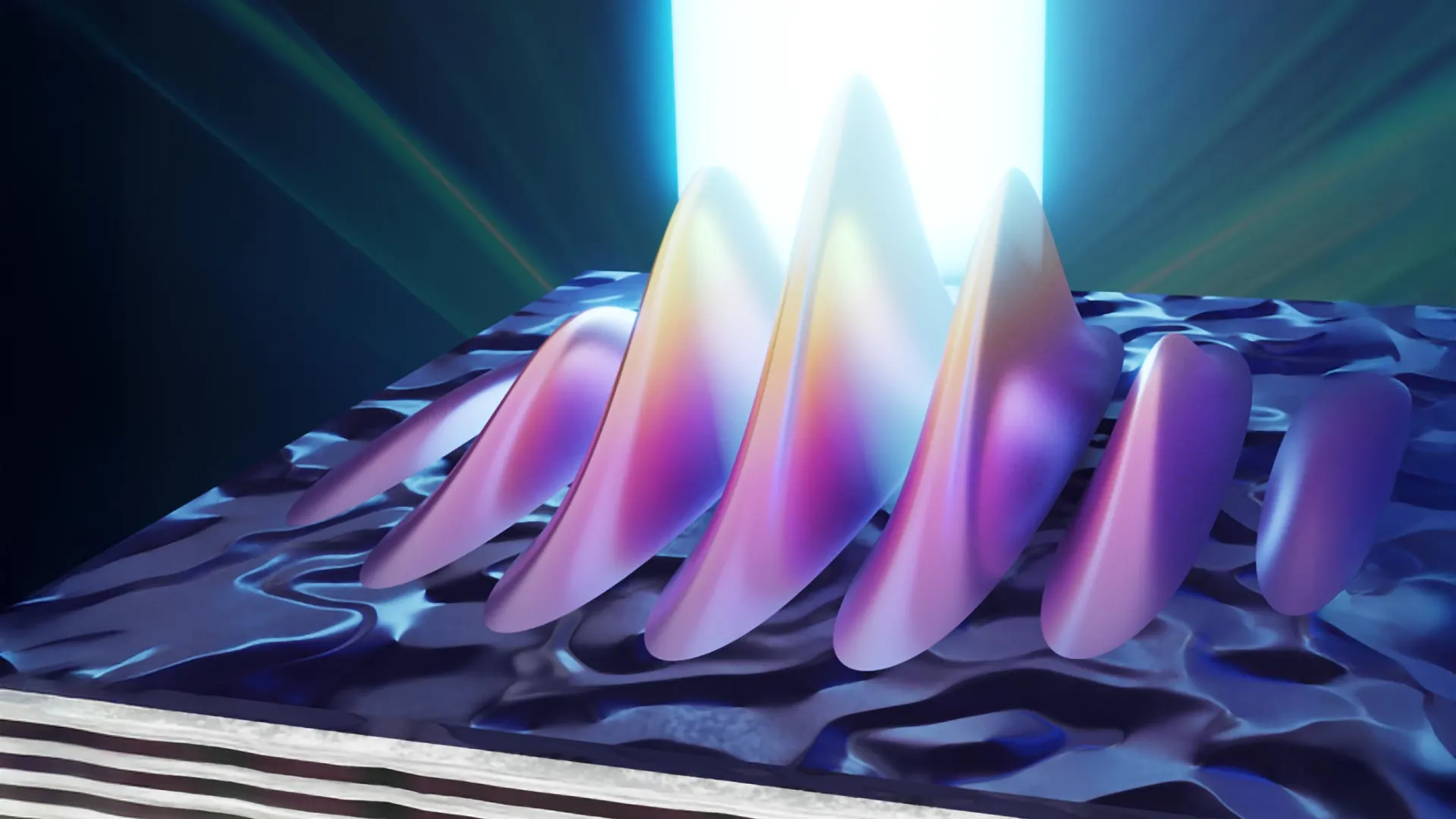
Scientists have demonstrated an extraordinary form of quantum matter that combines two properties that seem incompatible. Known as a supersolid, this unusual state has the orderly structure of a crystal while also displaying the frictionless flow associated with a special kind of liquid. Even more remarkably, researchers have now observed this behavior at room temperature, eliminating the need for the extreme cooling traditionally used to investigate such phenomena.
The breakthrough was achieved by an international team from the Faculty of Physics at the University of Warsaw, the Military University of Technology (Poland), IBM Research Zurich, and the French National Centre for Scientific Research (CNRS). Rather than relying on atoms cooled to temperatures near absolute zero, the scientists created a supersolid using particles that combine properties of light and matter. Published in Science Advances, the findings introduce a new way to investigate exotic quantum behavior under much more accessible conditions.
They could also help advance future technologies ranging from optical computing to highly sensitive sensors. How Can Matter Behave Like Both a Solid and a Liquid? Under ordinary circumstances, solids and liquids behave very differently.
Crystals have an organized internal structure, with their particles arranged in repeating patterns. Liquids, by comparison, can flow and change shape. Quantum physics, however, allows matter to behave in ways that would be impossible under the familiar rules of everyday life.
One example is superfluidity, a remarkable phenomenon in which a fluid loses its viscosity, or internal resistance to flowing. A superfluid can move through extremely narrow passages without experiencing the usual friction. Imagine placing an oar into such a liquid.
You would encounter almost no resistance until the oar reached a certain speed. Beyond that threshold, tiny swirling structures known as quantum vortices would suddenly form. During the 1960s, physicists proposed an even stranger possibility.
Extract — continue reading at the source.


