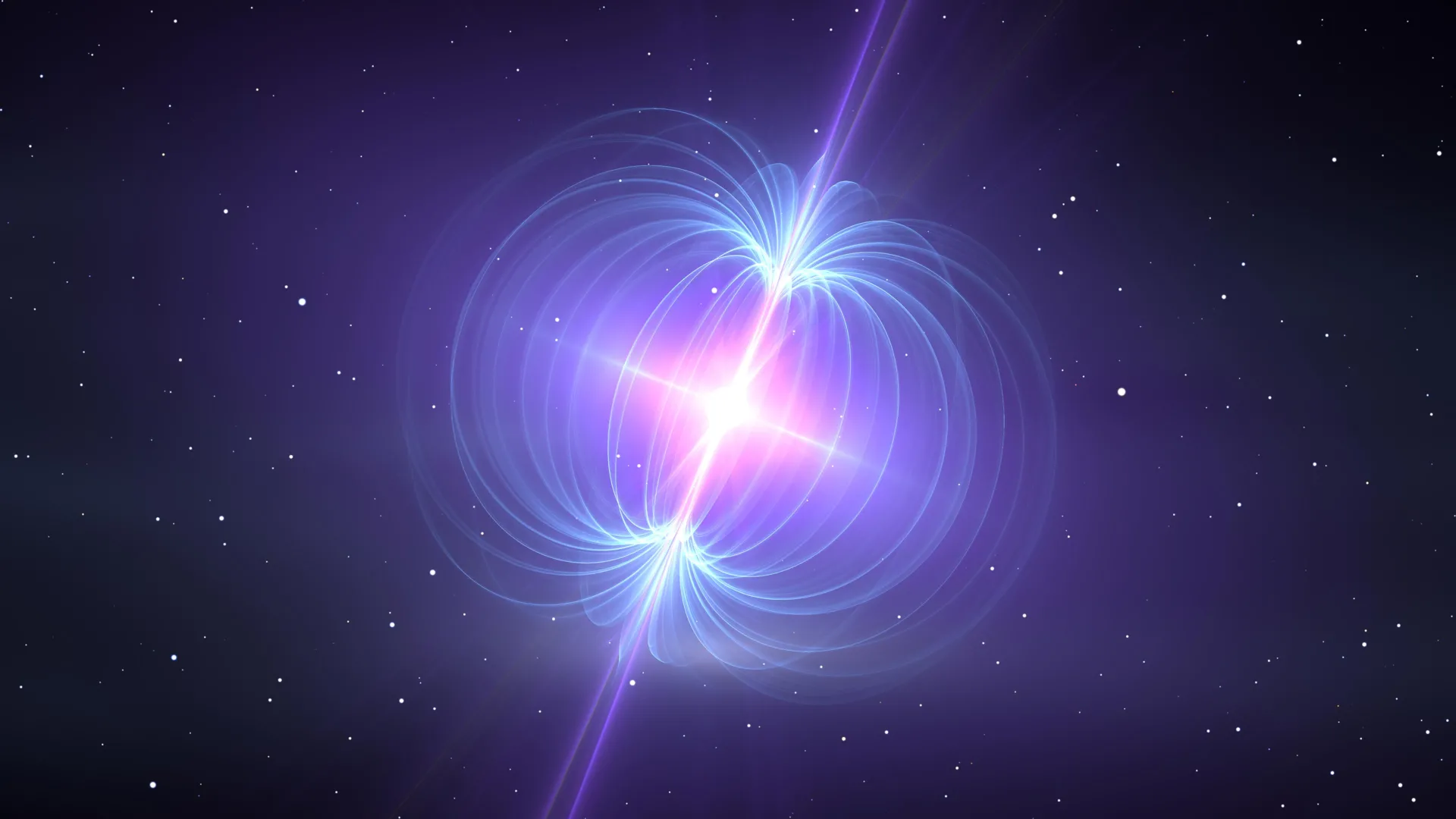
Astronomers have long relied on brief bursts of gamma rays to identify collisions between neutron stars. These flashes can vanish in less than two seconds. Now, new research suggests that some neutron star mergers may also produce X-ray flashes that remain visible for several minutes.
A study published in Science Bulletin presents strong evidence for that connection. The findings raise the possibility that some mysterious cosmic flashes, whose sources have been difficult to explain, may actually come from merging neutron stars. Since the Einstein Probe satellite launched in January 2024, astronomers have detected hundreds of bright X-ray flashes from distant galaxies.
These events, called fast X-ray transients, have several possible origins. Some have been connected to the deaths of massive stars, while others remain unexplained. Determining what causes them can be difficult because astronomers often do not know how far away the events are or how much energy they release.
Researchers in Professor Eleonora Troja's group, supported by a European Research Council (ERC) Consolidator grant, obtained observations that helped identify the source of one such X-ray transient. After receiving an alert from the Einstein Probe satellite, the team rapidly organized follow-up observations with several instruments, including the European Southern Observatory's Very Large Telescope (VLT) and the Very Large Array. By studying what remained after the explosion, the researchers concluded that they may have witnessed the formation of a magnetar produced by the collision (or merger) of two neutron stars.
Neutron stars are extremely dense stellar remnants left behind after massive stars reach the ends of their lives. When two neutron stars merge, they generate gravitational waves that travel through space. The light produced during these events can help astronomers determine what survives the collision.
Short gamma-ray bursts have traditionally been the main electromagnetic signal associated with neutron star mergers. "However, if the remnant of the collision is a magnetar, it could keep bursting for longer," said Prof. Troja, who is part of the Einstein Probe European collaboration and co-corresponding author of the paper.
Extract — continue reading at the source.


