BEIRUT — Yemen’s embattled government and a Saudi-led coalition have launched a major campaign aimed at dislodging Iran-backed Houthis who had recently seized vital parts of Yemen’s Red Sea coast. The offensive, which had already reclaimed territory overlooking a key waterway, marks a sharp escalation in what thus far been an ancillary conflict in the wider U.S.-Israeli war on Iran. In a televised address on Sunday evening, Rashad al-Alimi, head of the Yemeni government’s Presidential Leadership Council, announced a military operation to “extend the authority of the state and its institutions over the entire national territory.” The operation would continue, he said, “until the country is liberated from the control of terrorist militias.” The campaign comes almost a month after a blitzkrieg offensive by the Houthis saw Saudi-backed government forces collapse in disarray and give up wide swaths of territory along the Red Sea coast, including the Bab el-Mandeb Strait, an important maritime chokepoint.
The Houthis also made important gains inland, all but besieging the strategic city of Taiz, Yemen’s third-largest city, in a move that augured more Houthi advances. On Sunday, the group said it seized Turbah, a garrison town that lies on the sole supply route linking Taiz to Aden, a key port on the Arabian Sea. On Monday, Yemen’s military spokesman Majed al-Nuzaily said that “Operation Yemen Dawn” had launched more than 1,100 attacks against Houthi positions.
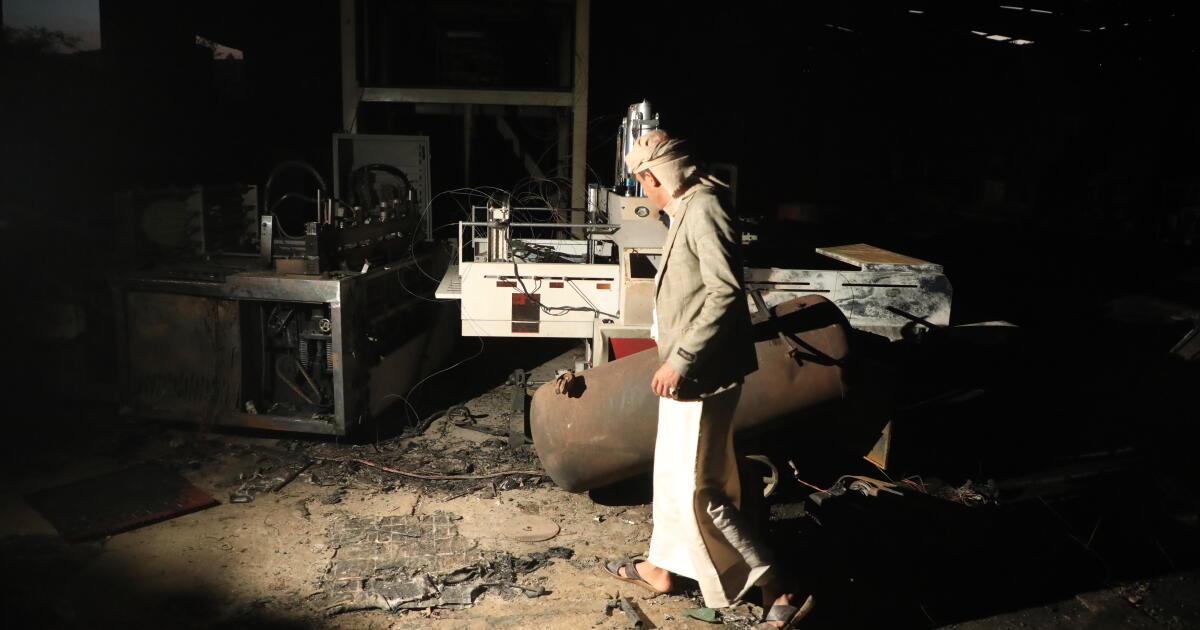
He added that pro-government factions succeeded in clawing back Mokha, the town of Bab el-Mandeb and a nearby airport from the Houthis — claims the group denied. Video posted on social media by activists accompanying pro-government factions depicted what was said to be the aftermath of attacks on Houthi positions along the Red Sea coast. We captured some of them, and the rest were killed,” said one fighter from the Giants Brigade, a pro-government group.
Turki al-Maliki, a military spokesperson for the Saudi-led coalition, said in a post on X that 100 warplanes participated in a Monday raid that destroyed 324 “high-value targets.” Later, he said the warplanes were providing “air protection” over the Bab el-Mandeb Strait as well as “round-the-clock air support for Yemeni armed forces on the ground.” When it was first formed in 2015, the Saudi-led coalition consisted of nine nations, including the United Arab Emirates, Qatar and Bahrain along with Egypt, Jordan, Morocco, Sudan and Senegal. The fighting represents the sharpest escalation since a 2022 ceasefire between the Houthis, Yemen’s government and Saudi Arabia broke down in July. Officially known as Ansar Allah (“Supporters of God”), the Houthis occupy much of Yemen’s north — its most populated section — and have long clamored for greater control over the rest.
Iran has incorporated the rebels as members of its anti-U.S. coalition, the so-called Axis of Resistance, and has provided weapons, training and other aid to the Houthis, which belong to a branch of Shiite Islam. The Yemeni government is a fragile body that, despite being internationally recognized, has no real foothold in the country it ostensibly rules. In the days after the ceasefire broke down, the Houthis announced a blockade on Saudi shipping, and launched attacks crippling Saudi Arabia’s oil export infrastructure.
That included the East-West Pipeline, the main conduit Saudi Arabia has used to circumvent Iranian and American closures of the Strait of Hormuz. Then in early September, the Houthis scythed through the Red Sea port of Mokha, along with Dhubab, Bab el-Mandeb and Perim Island. The offensive essentially granted the group control over the Bab el-Mandeb Strait — a move that rocked energy markets already made skittish by the U.S. and Israel’s war on Iran.
Extract — continue reading at the source.


