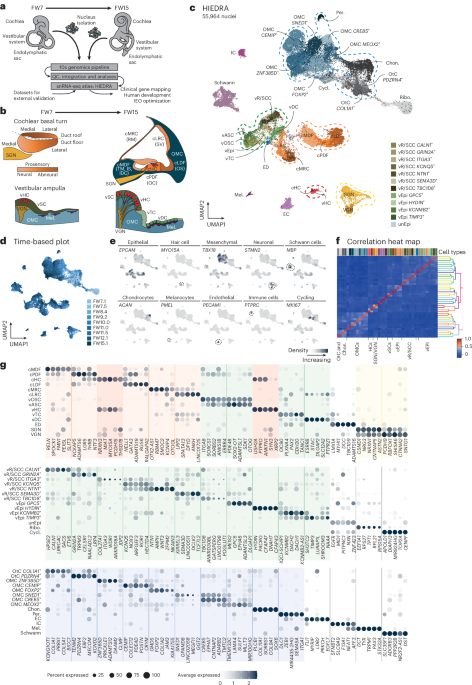
Hearing and balance rely on coordinated activity of multiple inner ear cell types, yet the mechanisms governing their development and specification in humans remain unclear. Consequently, this limits our understanding of how disease genes affect cell type formation and function, limiting the development of targeted treatments, including gene therapies. Here we present the Human Inner Ear Development snRNA-seq Atlas (HIEDRA), a single-nucleus transcriptomic atlas of the human inner ear spanning the first and second trimesters.
HIEDRA maps sensory and nonsensory epithelia, neurons and mesenchyme-associated populations, including undercharacterized secretory cells required for ion homeostasis. We identify selective vulnerability in sensory and secretory lineages to disease-associated genes, infer regulatory networks and show that Hedgehog signaling suppression is required for secretory cell specification. We validate this mechanism in human inner ear organoids, expanding the model to include all major cell types.
Altogether, these findings provide insights into human inner ear cell type specification, improve in vitro models and establish HIEDRA as a resource for investigating human inner ear development. Until recently, hearing and balance disorders were managed using neural prostheses such as cochlear implants or sensory strategies such as vibrotactile feedback. These technologies improve quality of life, but do not restore cellular function.
By contrast, emerging gene therapies aim to correct the underlying biological defects in genetic deafness1. This turning point is timely, as hearing and balance disorders affect around 5% of the global population and represent a growing challenge2. However, the success of gene therapy depends on three critical areas of knowledge: identifying which human inner ear cell types express disease-causing genes, understanding how these cells arise and differentiate during development and determining whether their regulatory programs can be modulated.
Current knowledge is incomplete on all three areas. While over 150 deafness-associated genes have been identified3, their expression across human cell types remains descriptive and incompletely mapped4. Although developmental pathways are well described in animal models, species differences may limit their translational relevance5.
Moreover, no established framework exists for identifying regulatory programs that control human inner ear cell fate. Transcriptomic technologies offer a promising path to address these gaps. Single-cell RNA sequencing (scRNA-seq) has transformed our understanding of human developmental biology and disease, enabling high-resolution mapping of cell types and trajectories in organs such as the skin6.
Extract — continue reading at the source.


