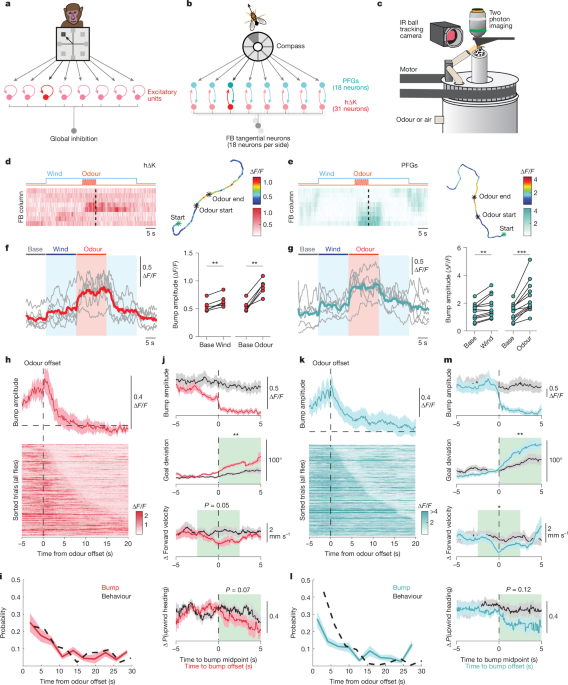
Recurrent attractor networks are widely thought to form the basis of working memory1,2,3, but how they can be rapidly switched on and off is unclear4,5,6,7. Here we investigate stability and switching in a recurrent circuit of the fly navigation centre8. h∆K and PFG neurons are recurrently connected in a ring structure and exhibit shared persistent bump activity that turns on with odour and terminates at the end of a goal-directed run. Using whole-cell recordings, we show that persistence in h∆K depends on recurrence, and that h∆K receives slow recurrent excitation and fast inhibition from its synaptic partners.
Computational modelling reveals that these synaptic dynamics yield persistent attractor dynamics over a range of synaptic strengths. Next we examine the mechanisms of rapid switching. We find that whereas both populations show similar activity during runs, they become decoupled during turns and rest.
We can reproduce these differential dynamics in our model by using inhibition to dynamically uncouple activity in h∆K from PFG. When h∆K is inhibited, PFG neurons follow their inputs from the compass system; when h∆K is disinhibited, recurrent interactions lock this input into place, forming a heading memory. Consistent with this model, we find that inhibitory inputs onto h∆K increase during turns and are suppressed during odour and goal-directed runs.
Our work reveals how disinhibition can serve as a gate to rapidly write an ongoing measurement to a recurrent circuit. Distributed networks of recurrently connected neurons are widely thought to form the substrate for short-term working memory1,2,3. During working memory tasks, neurons in the prefrontal cortex and elsewhere exhibit persistent activity that turns on with cue presentation and terminates with behaviour9,10.
The duration of persistence in these neurons is much longer than their intrinsic membrane time constants, arguing that persistence arises from network interactions3. Computational models that feature local recurrent excitation and global inhibition can recreate the types of persistent activity that are observed experimentally1,11 (Fig. 1a). However, such networks exhibit a fundamental trade-off between stability and flexibility1.
Networks configured to generate stable attractor dynamics are difficult to shut off once activated5. Computational models therefore often implement gates to control the timing of attractor dynamics4,6,7,12. How such gates might be implemented at a circuit and synaptic level is unclear.
Extract — continue reading at the source.


