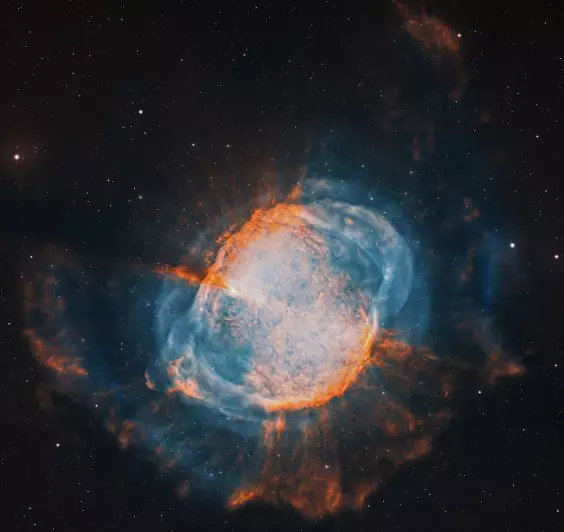
Fast-forward five billion years or so, and our own sun will look something like this: the Messier 27 (M27) planetary nebula, also known as the Dumbbell Nebula. It’s a vast cloud of gas and dust, ejected by a dying sun, and lit up by the star’s last embers. This spectacular image of M27 was captured by astrophotographer Andrew McCarthy, over the course of 30 hours and several nights, in order to avoid both the sun and the Earth getting in the way of the shot.
The “star smoke” is oxygen (the blues) and hydrogen and sulfur (the oranges), with denser clumps of gas showing up more visibly. Eventually, these cosmic materials get recycled into other stars and planets. For our solar system, the swelling will probably be enough to consume Mercury, Venus, and Earth, so if humankind is still around, it’ll need to have worked out how to survive somewhere else before that happens.
As the outer layers of a red giant get ejected into space, the star’s mass shrinks significantly, leaving behind a much smaller, blisteringly hot white dwarf star, which you can see at the center of this photo. (When astronomers say hot, they mean at least 85,000 Kelvin (about 152,540°F); our own sun burns at a comparatively cool 5,800 Kelvin (or 9,980°F) on the surface.) Read more: “This Nebula Looks Like a Shark” The light from the white dwarf gives us this incredible image, though the light show doesn’t last for long in relative terms—up to 25,000 years or so—and once the initial burning phase is complete, the white dwarf cools down over billions of years. (Fun fact: Planetary nebulae are so called because they can look planet-shaped—but there are actually no planets involved.) M27 sits around 1,360 light-years away from us, in the constellation Vulpecula, and has the honor of being the first planetary nebula ever discovered—by French astronomer Charles Messier in 1764. Back then, it would’ve appeared as an oval smudge of light, but some three centuries later, we’ve got a much closer—and colorful—look. Subscribe to our free newsletter.
Extract — continue reading at the source.