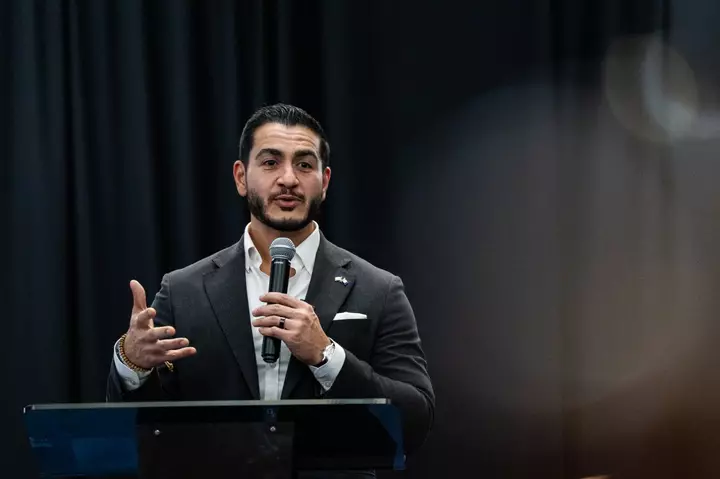
Senate candidate Abdul El-Sayed said Sunday night that he understood some Detroit residents might have reservations about him based on their experiences with people who look like him, adding that he wanted to be judged on his character. Speaking with MS NOW in the hours after former Democratic rival Haley Stevens switched her endorsement to Republican Mike Rogers, El-Sayed said he felt he had been consistent in his message as he seeks to win Michigan's open, Democratic-held U.S. Democrats need to take back control of the chamber.
El-Sayed has been a frequent target of Republican criticism, including attacks on his Muslim faith and attempts to portray his political views as extremist. "I know that for too many people in the city of Detroit, their interactions with people who look like me aren't very good," El-Sayed said. "They're being catcalled behind bulletproof glass in the gas station or a liquor store, watching kids get sold loosie cigarettes.
"But I'm asking to be judged by the content of my character, not the color of my skin, and I hope that in the U.S. Senate, I can be somebody who brings communities together so that we can build together what we can't have alone." Stevens, who currently serves in the House of Representatives, insisted that her decision to endorse Rogers was "not anti-Muslim at all" as she spoke outside a Detroit church Sunday. She and El-Sayed have publicly differed in their view on Israel's military campaign in Gaza.
Gaza health authorities say the campaign has killed tens of thousands of Palestinians. Newsweek reached out to El-Sayed and Rogers' campaigns for comment via email outside of normal working hours Sunday. Michigan has one of the largest Muslim populations in the U.S., with an estimated 241,828 Muslim adherents, equivalent to about 2.4 percent of the state's population, according to the 2020 U.S.
Census does not ask Americans about their religion. The state's Muslim population, as well as its Arab American and Middle Eastern communities, are largely concentrated around Wayne County and the metro Detroit area, particularly in Dearborn, which became a focal point of the 2024 presidential election. The city's 2020 census data showed 54.5 percent of residents identifying as having Middle Eastern or North African ancestry.
The communities grew over a significant period of time, including Arab migration to support Michigan's auto industry in the early 20th century, and later waves from Iraq, Yemen, and elsewhere in the Middle East. In 2020, President Joe Biden won Dearborn with 68.8 percent of the vote, compared with 29.9 percent for President Donald Trump. Trump's first administration had imposed travel restrictions on several predominantly Muslim countries, an issue that contributed to opposition among some Arab American voters.
Extract — continue reading at the source.