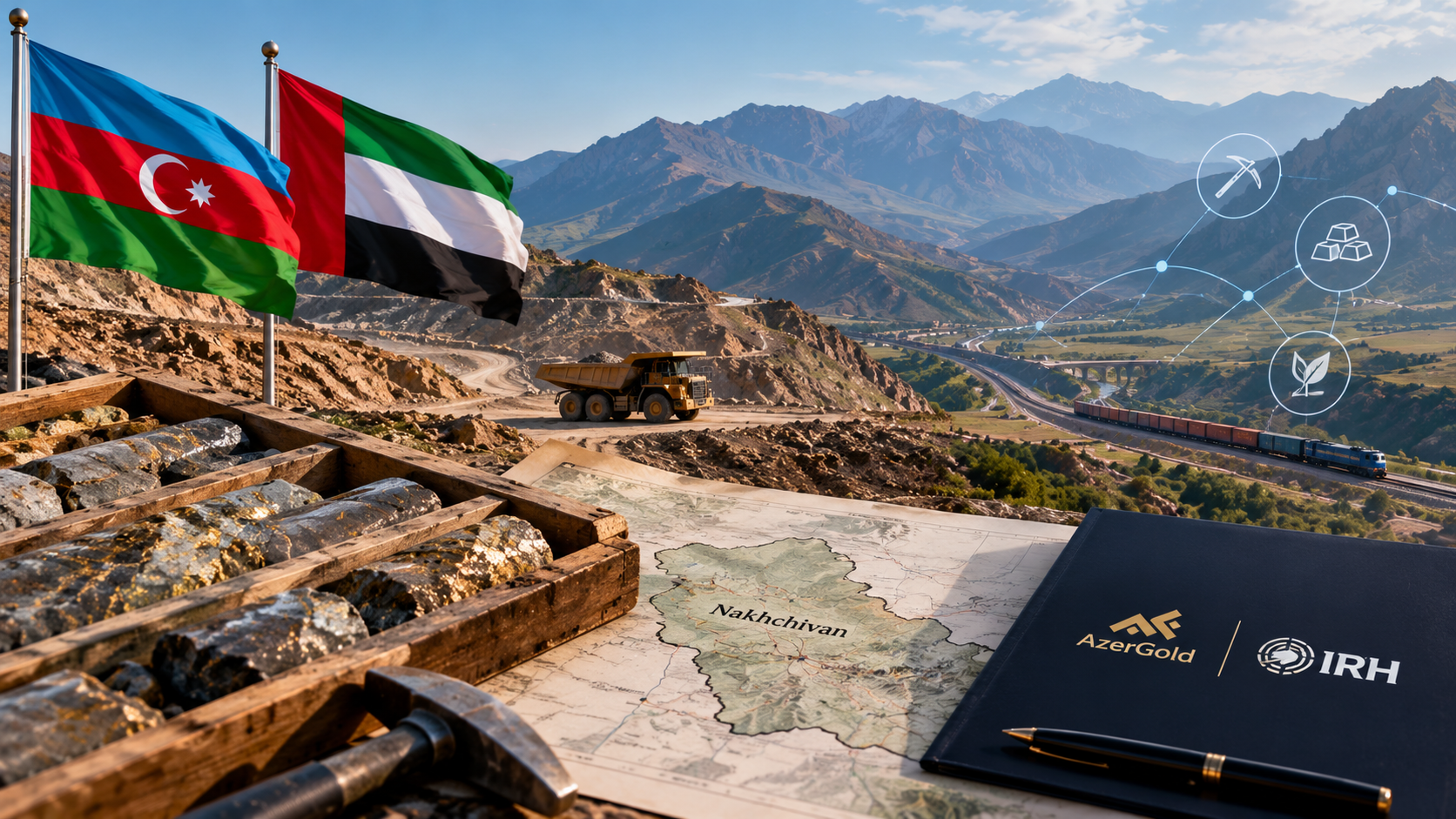
On September 14th, in a signing ceremony in Baku attended by President Ilham Aliyev and Sheikh Tahnoon bin Zayed Al Nahyan, the UAE's national security adviser and deputy ruler of Abu Dhabi, Azerbaijan and the United Arab Emirates put their names to a stack of agreements spanning renewable energy, artificial intelligence, digital infrastructure and gas. Buried in that stack, and easy to miss beside the higher-wattage AI headlines, was a single mining accord: AzerGold, Azerbaijan's state precious-metals company, agreeing to jointly evaluate and explore mineral potential across the Nakhchivan Autonomous Republic with Terra Mining, a subsidiary of Abu Dhabi's International Resources Holding (IRH). The statement is a relatively modest one - a template for geological surveys, not for a mine, let alone for a mining license.
Yet compared to the recent activities of its counterpart, it seems more like an initial bid than just some sort of formality. Now, one of the important points is that here is IRH's portfolio, where you can see that they don't engage in many small deals. In March 2024, it bought out a 51% interest in Mopani Copper Mines in Zambia – the biggest copper mine employer in the country, aiming to produce 200,000 tonnes of copper cathodes within three years.
Fourteen months after that, it took an additional $367m to purchase a majority stake in Alphamin Resources, DRC's leading tin producer. It has since announced its trading division's ambition to build up a portfolio of roughly 1m tonnes of copper a year by 2030. IRH is actually a wholly owned subsidiary of International Holding Company, whose listing in Abu Dhabi makes it the most valued listed conglomerate in the Middle East at a market value of more than AED 876bn (approximately $239bn).
All of which does not necessarily make Nakhchivan the next Mopani, but it does make it clear that the geologists exploring Julfa's gold-rich formations work for a company which, once decided to invest, generally invests in eight or nine figures. Because, over certain periods, Nakhchivan, being an exclave, struggled economically and even faced challenges in terms of keeping itself safe both physically and financially. So, in that sense, what does Azerbaijan bring to the table?
AzerGold is a smaller operation by comparison, but not a negligible one, and its trajectory helps explain why a state-run miner might welcome a partner with IRH's balance sheet. Revenue from gold and silver sales was $266.5m last year, up 46% from the previous year, while EBITDA increased by 58.5% to $142.5m, and net income grew more than double to $82.1m. The company's total assets amounted to $573.6m by the end of the year, which is 17.5% higher than the year before.
Over the last eight years, total revenue from the sales of precious metals exceeded $670m. Azerbaijan's gold production for 2026 has been estimated at 3,124kg, and its annual copper production stands at 5,300 tonnes, respectable figures for a country whose mining industry is overshadowed by the oil and gas one and whose gold reserves held by the central bank have grown from 184.8 tonnes to 200 tonnes within a quarter at the end of 2025. Nakhchivan specifically has already yielded credible geology: the Ortakend deposit in Julfa is estimated to hold some 424,000 ounces of extractable gold, and the Gumushlu polymetallic deposit in the exclave has been worked in various forms since Soviet times.
Extract — continue reading at the source.