Recent evidence implicates the renin angiotensin system (RAS) in various cognitive markers of depression, including dysfunctional reward processing. Yet, it remains unknown whether these effects extend to other markers implicated in depression and its treatment, such as approach-avoidance motivations that reflect innate drives to approach reward and evade harm. We sought to examine the impact of acute losartan, an angiotensin type 1 (AT1) receptor blocker, on the implicit approach-avoidance of facial expressions and checkerboard controls in healthy adults.
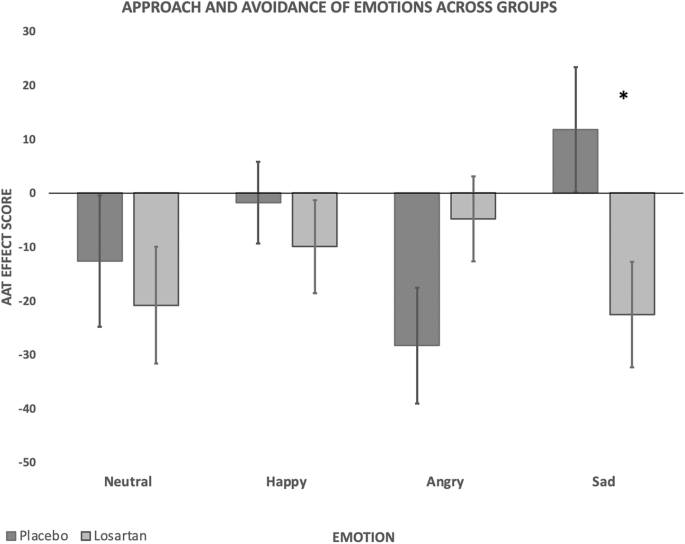
In a randomized controlled trial, N = 68 healthy adults aged 18–50 (49 F/19 M) were administered a single 50 mg dose of losartan or placebo before completing an implicit Approach Avoidance Task (AAT) at drug-peak level. On the AAT, participants responded to color-filtered facial stimuli (happy, sad, angry, or neutral) and checkerboard controls using a joystick, and were instructed to pull all gray photos and push all brown photos as quickly as possible. Compared to placebo, losartan induced a significant avoidance bias for sad faces (p = 0.027) and reduced avoidance of angry faces at trend level (p = 0.085).
This occurred without significant group differences on blood pressure, overall reaction time, accuracy, and approach-avoidance biases for other stimuli. The response pattern associated with AT1 receptor blockade may counteract previously observed depressive tendencies, suggesting effects possibly consistent with antidepressant treatments. Our findings further highlight the RAS as a mechanistically relevant target for psychiatry, suggesting that AT1 receptor antagonism may have relevance for treating depression and other emotional disorders characterized by aberrant motivational biases (Clincialtrials.gov ID: NCT06624904).
Depression is a severe psychiatric disease that affects 332 million people worldwide [1, 2], yet at least 30% of people do not respond to existing antidepressant treatments [3]. The limited efficacy of current treatments stems in part from an incomplete understanding of the neurobiological and cognitive mechanisms that contribute to depression. Clarifying these mechanisms may inform more comprehensive models of depression and support the identification of novel therapeutic targets, which could improve treatment efficacy.
Recently, researchers have increasingly implicated the renin angiotensin system (RAS)—known for its canonical role in blood pressure regulation—in the psychophysiology of depression and related disorders, such as anxiety [4, 5]. For instance, in rodents, administration of angiotensin type 1 receptor blockers (ARBs) produces antidepressant-like and anxiolytic effects [6,7,8]. Further, hypertensive patients receiving RAS-modulating drugs show reduced onset and recurrence of depressive disorders, undergo fewer mood disorder-related hospitalizations, and self-report enhanced quality of life compared to patients receiving non-RAS antihypertensives [9,10,11].
Together, these preliminary findings suggest that the RAS, and more specifically the angiotensin type 1 (AT1) receptor, may be implicated in depression and related pathologies. Extending this work, experimental studies have begun to delineate specific cognitive processes that are relevant to depression and sensitive to RAS modulation. In healthy adults, a single dose of the ARB losartan biases learning toward rewards relative to losses [12, 13] and enhances the salience of social reward while diminishing the salience of social punishment [14].
Extract — continue reading at the source.


