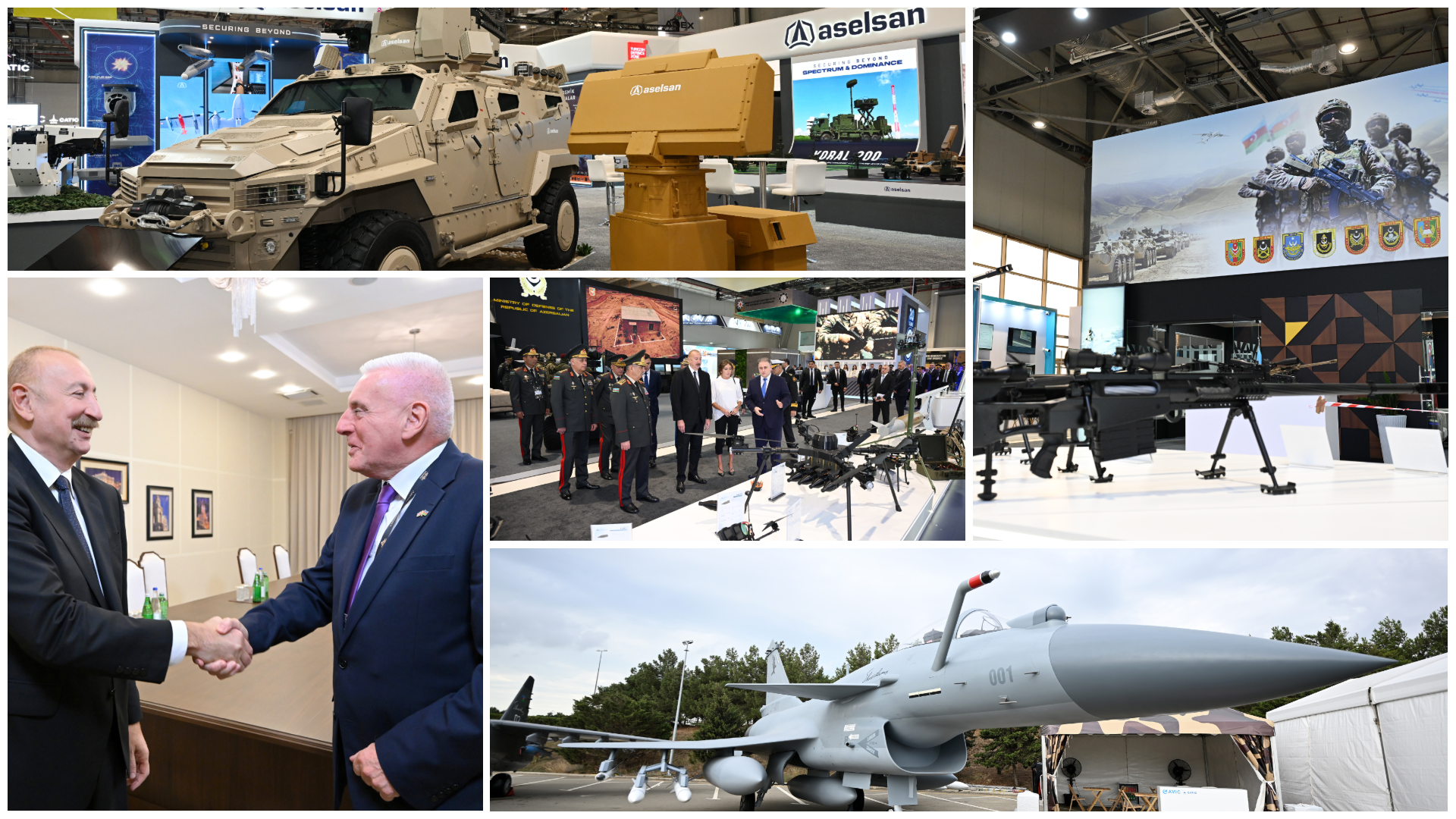
Walk the halls of the Baku Expo Center this week and you could, in theory, outfit a small army, tanks from China, loitering munitions from Israel, anti-drone systems from the UAE, and the ammunition to keep them all firing from half a dozen countries besides - that was my impression in my first thirty minutes at the venue. That, more or less, was the point of ADEX 2026, the sixth Azerbaijan International Defence Exhibition, which opened alongside its sister event Securex Caspian on September 30th with President Ilham Aliyev and First Lady Mehriban Aliyeva touring the stands. The main story this time, per se, was that Azerbaijan was the one selling.
The sheer size of the event already set it apart from other editions of ADEX. Organisers even had to put up an additional pavilion at the Expo Center in order to accommodate all the exhibitors, and for the first time ever, a special hall was dedicated exclusively to hosting a national exhibition of domestically manufactured weapons and military equipment. Numbers bear witness to the expansion as well: in total, 277 companies from 30 countries participated in both events, with 59 foreign delegations from 39 countries registering and 14 national pavilions being hosted.
The largest group of exhibitors came from Türkiye, which is not surprising in light of the "one nation, two states" defence cooperation model established between Baku and Ankara after the Karabakh conflict in 2020. For the first time in history, some major American defence contractors also showed up at ADEX, which Azerbaijani representatives were eager to emphasize, one of them being Lockheed Martin. The exhibitors list was like a roll call of the biggest names in the international arms trade.
Turkish aircraft manufacturer Baykar, builder of the TB2 drone, which has customers in over 30 countries, had its jet-engined Kizilelma unmanned combat air vehicle together with the carrier variant TB3. Turkish electronics firm Aselsan, placed among the top 50 defence manufacturers in the world, exhibited radar and electronic warfare systems. The United Arab Emirates' EDGE Group, formed in 2019 through a merger of over 25 companies and now ranking in the top 25 worldwide, had precision-guided munitions on display.
Israeli defence industry included IAI, Rafael and Elbit Systems - producers, respectively, of the loitering munition Harop, the anti-missile system Iron Dome and the Hermes series. Chinese aerospace and armoured vehicle industries were represented by China National Aviation Industry Corporation International and China North Industries Corporation, a stone's throw away from German company Rheinmetall and British BAE Systems, Europe's largest defence corporation. Even Russia's Rosoboronexport had a presence, a reminder that Baku's defence diplomacy runs through Moscow as readily as through Washington or Ankara.
From buyer to builder, Azerbaijan aims high What has genuinely changed since Azerbaijan's earlier defence fairs, though, is the weight given to the host country's own industry. Azersilah, the Defence Industry Holding President Aliyev created by decree in 2023, anchored the national pavilion, showing artillery components, unmanned systems and the kind of hardware that, a decade ago, Azerbaijan would simply have imported. The holding's remit, consolidating what had been scattered, ministry-run factories into a single entity capable of forming joint ventures and courting foreign investment, reflects a deliberate industrial-policy choice rather than mere showmanship.
Extract — continue reading at the source.