/https://tf-cmsv2-smithsonianmag-media.s3.amazonaws.com/filer_public/31/eb/31ebdfc9-0df0-4f8b-9103-77d6dfdb4483/smithsonian_feature_images_15.png)
Mercury, the solar system’s smallest planet and the one closest to the sun, hasn’t received as much love as its celestial neighbors. It’s the least explored of the inner solar system planets, which also include Venus, Earth and Mars. But the BepiColombo mission, by the European Space Agency (ESA) and the Japan Aerospace Exploration Agency (JAXA), will help change that.
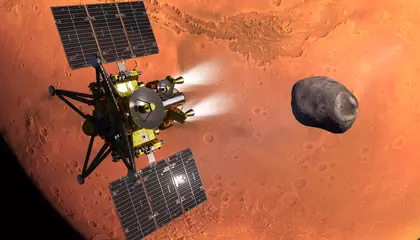
It’s finally in the homestretch of an eight-year-long voyage to the tiny planet. On September 3, BepiColombo initiated its arrival phase, when the module that powered and propelled the journey separated from two spacecraft that will collect data about our planetary sibling. They include ESA’s Mercury Planetary Orbiter (MPO) and JAXA’s Mercury Magnetospheric Orbiter (Mio).
The occasion marks the start of one of the most complex planetary arrival sequences ESA has ever attempted. If all goes according to plan, the connected spacecraft will start looping around the planet on November 21 and separate from each other about three weeks later. They’ll begin collecting scientific data in April 2027.
That poses challenges in terms of the thermal behavior of the spacecraft, in terms of the radiation levels we get from the sun.” For comparison, ESA’s Solar Orbiter also gets very close to the sun, but it then has six months to cool down when it nears Venus, Sousa explained. BepiColombo won’t have any such respite, because its distance from the sun will remain roughly the same year-round. Quick fact: Our solar system’s pint-size planet Mercury is about one-third the width of Earth.
It’s only a bit bigger than our moon. Its journey to the planet, which began with an October 2018 launch, was tough too. It required a lot of energy because Mercury is so close to the sun, and so spacecraft headed there must frequently brake to resist our star’s strong gravitational pull.
In fact, experts suspect that this trip requires more energy than getting to the dwarf planet Pluto. For BepiColombo, “we obtain most of the energy to get to Mercury from the flybys” near other planets, whose gravity slowed the orbiters, says Johannes Benkhoff, ESA’s project scientist for the mission, in a statement. They must slow to just the right speed; if they’re traveling too fast, they’ll shoot past the planet.
Extract — continue reading at the source.