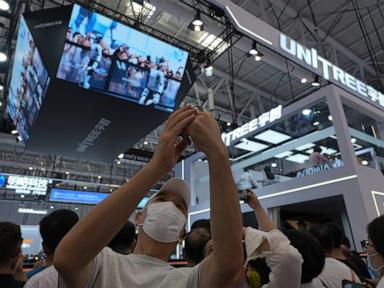
In July, CXMT, China’s largest memory chipmaker, raised more than $8.6 billion in Shanghai in the second-largest IPO for its Nasdaq-style STAR market, mainland China’s second-largest IPO. Its shares jumped 466% on the first day of trading. Unitree, one of China’s leading humanoid robot makers, also made its listing debut in Shanghai in August.
Shares rose 460% on the first day of trading. Trading in Shanghai's stock market, for one, is heavily driven by retail investors. CXMT’s IPO in Shanghai “placed China in a strategically significant position in tech manufacturing related to AI,” said Perris Lee, head of APAC equity capital markets for ION Analytics.
IPO proceeds in Hong Kong and Shanghai so far this year have already surpassed the funding raised last year, according to the financial data platform LSEG. It says IPOs and secondary listing activities on the Hong Kong and Shanghai exchanges raised a total of over $54 billion from so far in 2026, surpassing last year’s total of more than $46 billion. Combined Hong Kong and Shanghai proceeds so far this year accounted for roughly 21% globally, ranking them only behind only the Nasdaq’s roughly 55% global share, LSEG said.
There, the mega $75 billion IPO by SpaceX in June made the U.S. exchange the world’s biggest IPO market this year. Since China limits foreign purchases on mainland exchanges, many Chinese companies do parallel listings in Hong Kong to help raise international capital. Stricter U.S. and Chinese regulatory scrutiny in recent years of big Chinese companies listing in U.S. markets, especially those in strategically important sectors like advanced technologies, has led some Chinese companies to stick closer to home.
Listing overseas typically takes more time compared with doing IPOs in China, said Howie Farn, a capital markets partner at the law firm Freshfields. In Hong Kong, recent public stock listings of Apple-supplier Luxshare Precision Industry, and Zhongji Innolight, which makes optical transceivers used in data centers, were among this year’s largest deals and were also a reflection of investor demand for advanced technologies. More companies are looking to hold their IPOs in Hong Kong or Shanghai, like robotics firms AGIBOT and Deep Robotics.
Shein also explored the possibility of listings in the U.S. and London before opting for Hong Kong. After massive oversubscriptions and huge gains in their share debuts, some companies have seen their market value shrink. Chinese robot maker Unitree’s share price had fallen more than 40% as of Friday from its peak share price on the day of its trading debut.
Extract — continue reading at the source.