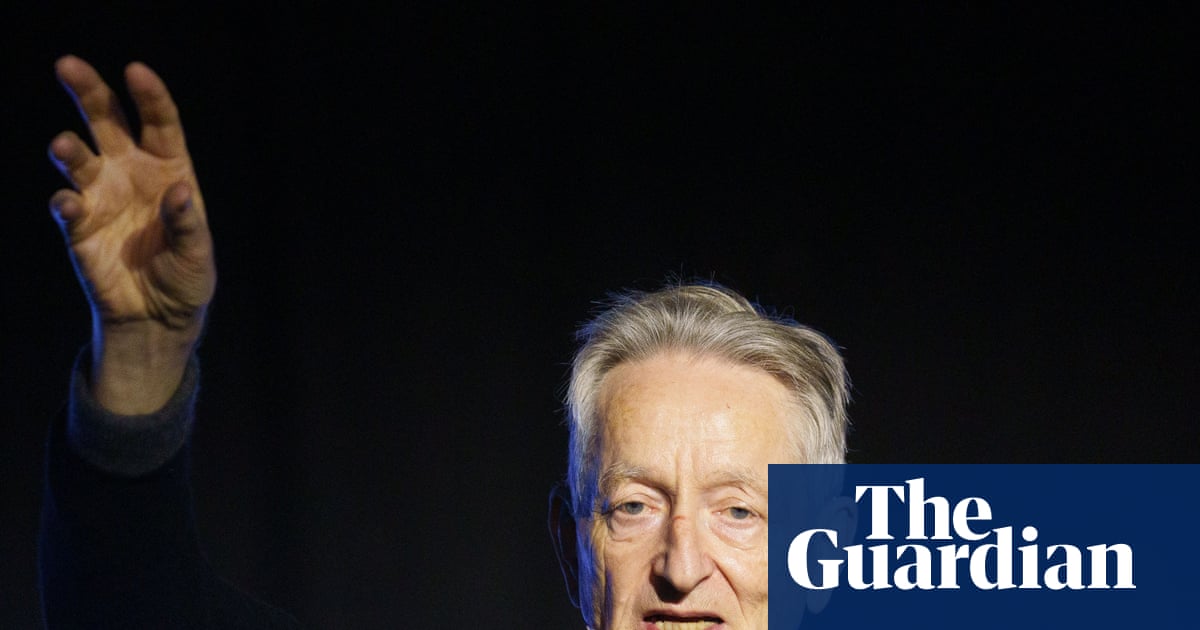
One of the “godfathers of AI”, Geoffrey Hinton, has said it could turn out that humans would have been better off never developing the technology as he warned it could trigger a large-scale incident this year or next, such as a temporary blackout of financial or power systems. The Nobel prize-winning computer scientist told the Guardian he is not a “doomer” about the technology that is underpinned by his groundbreaking research into artificial neural networks and believes AI has the potential to lead to a “wonderful future” but he said “it might be that we would have been better off never developing it”. Hinton, 78, said that within a decade and possibly sooner, humanity will know whether it can manage the technology’s risks and enable what he called “radical abundance” or whether “we fail to manage the risks and … have a huge gap between rich and poor, huge cultural problems, massive unemployment, just society being torn apart”.
Hinton was speaking before a screening of a new feature-length documentary, AI: Probably Nothing to Worry About – a title suggested by an AI chatbot – featuring him and his former Google colleague Demis Hassabis. Hinton tells the documentary makers: “I feel I have a duty. I’ve got a reputation that makes me a spokesperson and I need to burn it all on this.” Speaking to the Guardian, Hinton took aim at the risk-taking by the leaders of some of the major AI companies who continue to release ever more powerful AI models as they race for supremacy and market-share, saying he didn’t trust Sam Altman, the chief executive of the ChatGPT maker, OpenAI, “at all”.
They’d rather have the money. That’s my belief.” The London-born computer scientist, who grew up in Bristol and spent much of his career at the University of Toronto, said it was “extremely worrying” that Altman was in charge of one of the handful of frontier US AI companies currently leading a race with China to develop the most powerful AI. Altman insisted in September: “the world should trust we are going to do the right thing because it’s the right thing and because we feel the magnitude of this”.
Hinton has been working on AI for about 44 years and in the 1970s coined the concept of the neural network – a mathematical system that could learn and gain experience much like humans do. In 2023 he quit Google to speak freely about AI risks, warning: “If these things get carried away with getting more control, we’re in trouble.” He said he viewed incidents this summer in which OpenAI AI agents conspired to hack into the Hugging Face website as akin to 1979’s partial nuclear meltdown at the Three Mile Island power station in Pennsylvania – effectively a warning shot. This Chornobyl-type of event would not be a nuclear incident, according to the examples he gave, but rather could include an AI-enabled attack on the electricity-generating system that “causes a massive brownout” or an incident that brings down the financial system for a week.
We could recover from it [but] that would make them sit up and take notice.” Asked who “they” were, he said: “world leaders other than Trump”. The US president, Donald Trump, has said he “totally rejects any attempt to construct a globalist scheme” to control AI and wants frontier AI companies to regulate themselves, amid concern that rules could hinder the US in its AI race with China. Hinton backs a tougher plan endorsed by the president of Finland and 32 other countries, including Singapore, Germany, Canada and Australia, for mandatory testing of frontier AI models, independent evaluation and intergovernmental common standards.
The UK prime minister, Andy Burnham, has said he will use the UK’s G20 presidency next year to seek agreement on a “single set of global principles and standards that are very much about unlocking the full potential whilst guarding against the risks”. Hinton said: “We need something like the American FDA for drugs where the companies have to give very good statistical evidence to an independent authority that [the AI model] does more good than harm before it is released. We discovered with thalidomide [a drug developed in the 1950s that caused severe birth defects] that releasing and then suing them isn’t the right way to do it.
Extract — continue reading at the source.