Ask most executives to picture the cost of AI and they’ll likely see GPUs—racks of accelerators with gigawatts of power—and a waitlist for silicon. But that picture leaves something out: Data storage costs. What happens to data after a model responds?
Much of the back-end data that’s generated—from billions of daily prompts, images, and videos—needs to be stored. But data storage is one of the harder infrastructure costs to plan for, and it’s often overlooked in initial AI infrastructure planning. Traditionally, AI infrastructure conversations have centered on the compute-intensive process of training a model.
Training is finite: a run starts, burns through compute, and ends. But inference runs continuously, every time a model answers a prompt. For infrastructure planning, that difference matters: A training run is a project you can budget for and retire.
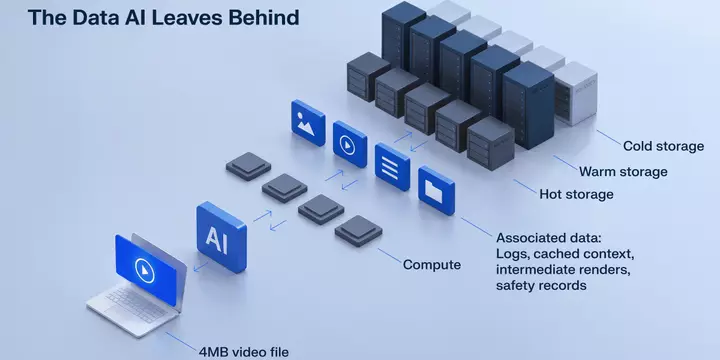
Inference doesn’t retire; every inference request leaves something behind. In this workload, the back-end spend can be significant. From internal measurements, WD found that an 8-second clip (returned to a user as a 3.97MB 720p file) left more than 500MB of associated data behind on the back end, including logs, cached context, immediate renders, backups, and safety records.
That’s a 130x increase over the output file size the user saw. Scale this to an enterprise generating longer, higher resolution video and the back-end footprint grows into the hundreds of gigabytes per clip. And that back-end footprint is growing fast.
McKinsey projects AI inference demand will grow at a 35% CAGR through 2030, versus 22% for training, making up more than 40% of total data center demand by the end of the decade. A recent WD-sponsored IDC global white paper that surveyed 763 IT and business decision makers found that nearly 95% of respondents reported an increase in data volume due to generative AI over the past 12 months, with roughly 61% reporting growth of 25% or more. Compute demand rises and falls with training cycles, product launches, and hardware refreshes.
Extract — continue reading at the source.