The German Peasants’ War was the largest popular uprising on the European continent until it was surpassed by the French Revolution over 250 years later. Erupting in 1524 in today’s southwestern Germany and France’s Alsace region, the uprising tore across the Holy Roman Empire, eastward beyond Salzburg and northeast almost as far as Leipzig by the spring of 1525. Feeding on the energy of the Protestant Reformation, the peasants rose up against local nobles that had been increasing taxes and reducing access to common pastures and woodland in the Holy Roman Empire for several decades.
They were encouraged by radical preachers like Thomas Müntzer, who saw a necessary link between social and religious upheaval. The bands of peasants won early victories, plundering the Kempten abbey and capturing the castle at Weinsberg, but retaliation was swift and brutal. The necessity of suppressing the revolt united Catholic and Lutheran nobles.
They defeated the peasants at Frankenhausen in May 1525, capturing Thomas Müntzer and eventually burning him at the stake, and massacred several thousand retreating peasants at Böblingen. The revolt was suppressed by that summer and the rule of territorial princes restored, often on harsher terms than before. This revolt saw economic, social, and religious motivations intermix, forging unexpected alliances and inaugurating an age of autocratic rule.
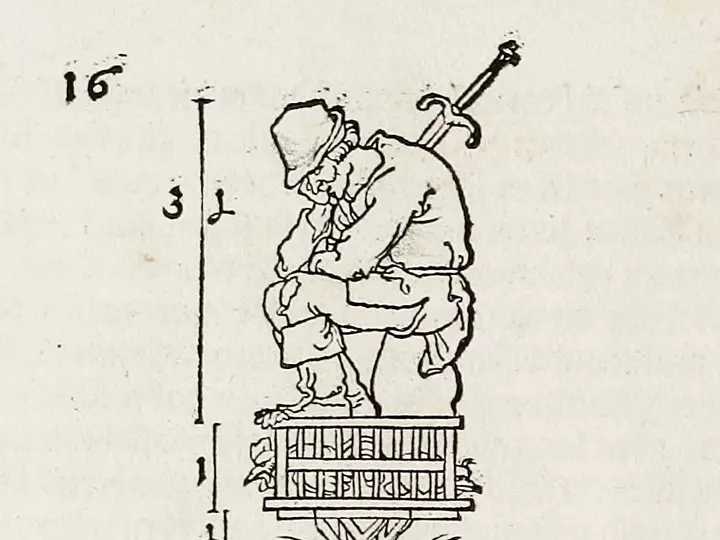
It is perhaps apt that this popular uprising, manifold in its causes and convoluted in its course, would be memorialized by a design for a somewhat extravagant monument: a lard tub balanced atop a chicken basket, resting upon a bundle of peasant tools, extending from a butter keg, sitting on a plate covering a cheese bowl, on a kettle set upside down upon a chest. At its pinnacle, the monument’s finial, crouches a peasant, slain or asleep, with a sword’s hilt sticking out of his back. Perhaps unsurprisingly, this multifarious monument, which Albrecht Dürer devised in 1525, was not intended to be built. (The same is presumably true of the monument that Dürer devised following the peasant tower: one for a drunkard, featuring a beer barrel on his grave, with an epitaph that “praises sensual pleasure mockingly”.) Scroll through the whole page to download all images before printing.
Albrecht Dürer’s proposed bestial base for the vanquished-peasants monument, from 1525’s _Unterweisung der Messung_ (Treatise on Measurement) — Source. An object lesson in Dürer’s _Unterweisung der Messung_ (Treatise on Measurement), it served as an example to illustrate the proportions of monuments. The engraving that serves as a diagram for the “Monument to the Vanquished Peasants” is accompanied by a meticulous prose description of the monument’s dimensions.
In arranging its elements so carefully, Dürer seems to sublimate these everyday objects into symbols — but symbols of what? The finial peasant exudes a resigned pathos that undermines whatever supposed victory this column would fête, but it is difficult to assign any straightforward meaning to it. As art historian Erwin Pankofsky has argued, Dürer was an ardent supporter of Martin Luther, and his text does indeed speak of erecting monuments for those that have “prevailed over the mutinous peasant”.
Extract — continue reading at the source.