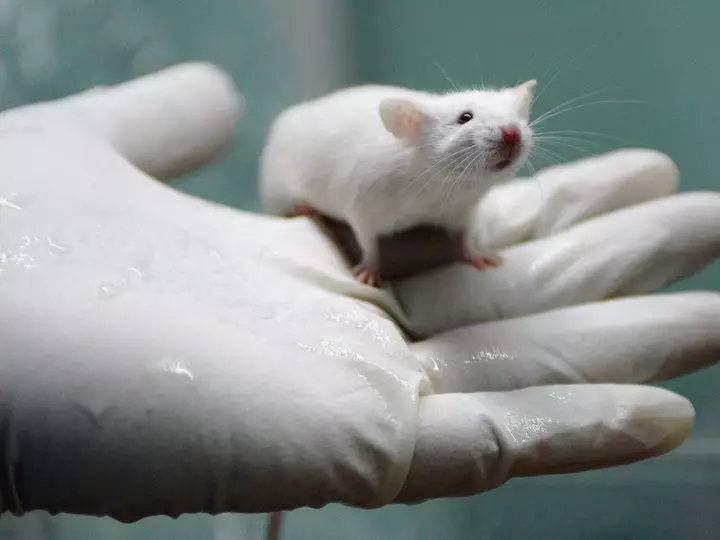
In a laboratory in California, in the United States, mice are scurrying around their cages, as mice do. But inside their brains are millions of working human neurons. Researchers at Stanford University have implanted lab-grown human cells into mice genetically engineered to lack parts of their brains, including the cerebral cortex, the outer region that plays a major role in perception, movement, decision-making and attention.
According to a study published in Nature, these so-called “alien-cortical mice” may offer a new way to study neural circuits and brain disorders such as schizophrenia, cerebral palsy and dementia. Putting human brain tissue inside an animal sounds like something out of Mary Shelley’s Frankenstein, but how “human” are these mice, really? And what have the researchers found?
Researchers genetically modified the mice so they were born and grew without most of the cerebral cortex and the neighbouring hippocampus, which are needed for movement, learning and memory. When the animals were two days old, researchers injected human “organoids” into the empty spaces. Organoids are miniature masses of cells grown in a laboratory from stem cells or tumour tissue which mimic real human organs.
Each was grown from healthy donors’ stem cells and holds about 100,000 human cells. Overall, researchers removed about 14 million mouse neurons and added about 4 million human ones. This is not the same thing as a brain transplant, and the animals are not “mice that think like humans”, the researchers emphasised.
They tried the transplants on 29 mice, and it worked on 25 of them. Within three months, the human tissue had grown about five times larger inside the mice’s brains, connected to their blood supply and filled more than 90 percent of the cavities. The “alien cortex” mice walked and vocalised mostly normally, even though human tissue made up about half their brain volume.
In a maze test, mice without the implanted human tissue kept getting lost, however, while those with human cells did better, suggesting the human tissue contributed to cognition. Unexpectedly, some of the tissue developed into von Economo neurons, which are long, rare cells normally absent in mice and almost impossible to make in a lab. They are found in highly social animals such as humans, apes, whales and elephants.
Extract — continue reading at the source.