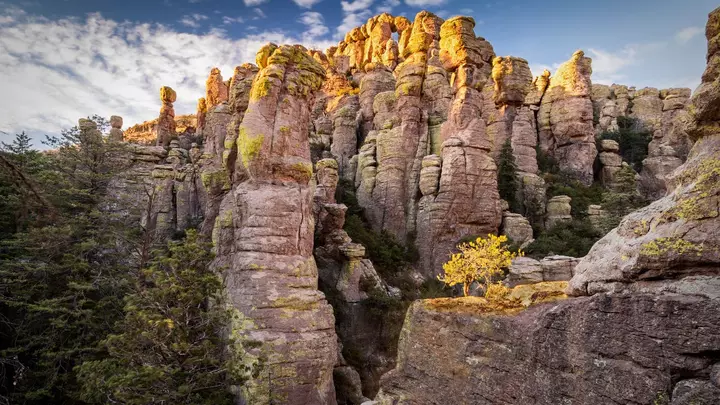
Sunset along the Echo Canyon hiking trail among hoodoos and rock pillars at Chiricahua National Monument near Wilcox Arizona. ( ) What to know: Chiricahua is the first U.S. national park in six years. The bill to redesignate Chiricahua National Monument as America’s 64th national park was passed by the Senate on September 30, 2026, and signed by President Trump on October 20. Our writer shares what it’s like to visit Chiricahua, hiking its winding trails alongside towering rock pinnacles and incredible biodiversity.
Chiricahua, located 120 miles east of Tucson, is now the state’s fourth national park, joining Grand Canyon, Petrified Forest, and nearby Saguaro. The trail we are hiking isn’t strenuous, but my husband and I, committed-relationship status as fresh as the snow under our feet, are struggling for words. Rock stacks rise above our heads, and hundreds of pinnacles dot the landscape beyond.
Boulders splashed with lime green and black lichen perch nonchalantly atop each other, and canyons wind around rusty outcrops. Being in the middle of Chiricahua National Monument feels like being dwarfed by a sea of massive navigation cairns and those knobby towers of dribbled sand children make at the beach. The Apache name for this place translates to “Land of Standing-Up Rocks.” It’s a succinct, accurate description compared to what our pens scribble in the first pages of our joint adventure journal.
Exploring Chiricahua National Monument will become a core experience on our honeymoon trip and, standing in the forest of stone searching for ways to voice our amazement, we know it. Memories of that mesmerizing hike, which we did this past February, rushed back into our minds today. On October 20, 2026, 102 years after it was first named a national monument, Chiricahua became the first U.S. national park in six years.
The bill to redesignate Chiricahua National Monument, located 120 miles east of Tucson, as a national park was passed by the Senate on September 30, 2026, and signed by President Trump on October 20, 2026. To those with personal, historical, and scientific ties to Chiricahua, this is a big moment. A monument is designated by a president—in Chiricahua’s case Calvin Coolidge— via the Antiquities Act of 1906, often to protect a singular specific resource.
To be eligible for national park status, a place usually boasts a vast chunk of scarce resources or a particularly scenic landscape worth protecting. From the ground on the Echo Canyon trail, one of several trails of varying difficulty that weave through boulder spires, the natural and recreational value of Chiricahua is obvious. Despite other areas of significant natural and historical beauty also in the race to become America’s 64th national park, Chiricahua is special, and not only to us.
Extract — continue reading at the source.