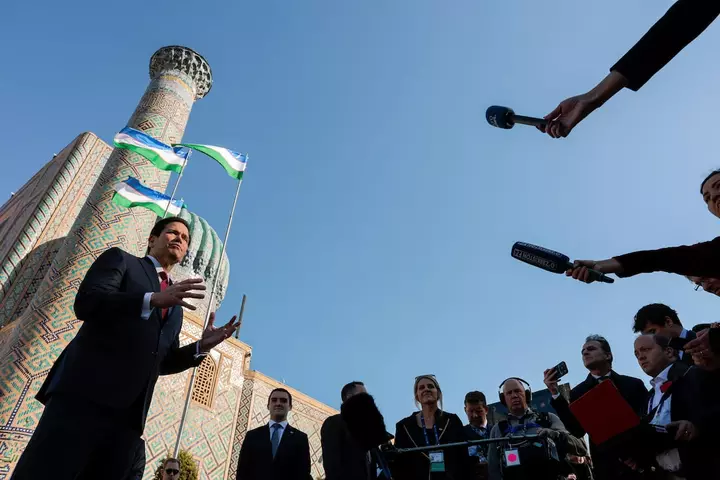
"Who rules East Europe commands the Heartland; who rules the Heartland commands the World-Island; who rules the World-Island commands the world." Halford Mackinder wrote that sentence in 1919, and diplomats have quoted it ever since, usually to make a point about Russia. This week it found an unlikely new audience in Samarkand, the Silk Road city where America's secretary of state, Marco Rubio, convened the foreign ministers of Kazakhstan, Kyrgyzstan, Tajikistan, Turkmenistan and Uzbekistan, with more than 100 American companies behind him. The numbers were designed to impress.
Uzbekistan announced 54 agreements, potentially worth $12bn, at a business council attended by some 400 delegates. It follows the White House summit last November, which produced more than $25bn in announced deals, including Boeing orders from Uzbekistan Airways and Tajikistan's Somon Air. The joint statement issued on October 19th pledges "enduring partners of choice" and a Central Asia that "returns to the center of the global economy".
Rubio promised "concrete deals", and Tashkent produced a list. Uzbekistan has claimed an incredible 54 deals worth an estimated $12bn at a business forum that attracted some 400 participants. This follows the White House gathering in November, which yielded more than $25bn in announced transactions, including orders from Uzbekistan Airways and Tajikistan's Somon Air for Boeing aircraft.
The statement of cooperation agreed upon on October 19th speaks of "enduring partners of choice" and a Central Asia that will again be "at the heart of the global economy". Rubio wanted "concrete deals"; in return, Tashkent delivered. Now, let’s strip out the diplomatic verbiage; the reasoning is geostrategic in the most classical sense.
Central Asia lies at the intersection of Russia, China, and Iran; it is the only part of Eurasia where all three countries seek a stake in the region, and none controls the game. Russia’s conflict with Ukraine has made Russia an unappealing headquarters for multinational companies, forcing the region’s governments to diversify. China has become the most powerful external investor in the region and increasingly builds the region’s telecommunications networks and renewables, services, mines, and pipelines.
The strategic intent of the United States here is clear: to prevent the continent from uniting into a closed Eurasian landmass on its own terms, wired to Western supply chains. But it would be wrong to think that this is a discovery. An ex-official of the US Department of State who was responsible for Central Asian policies during the George W.
Extract — continue reading at the source.