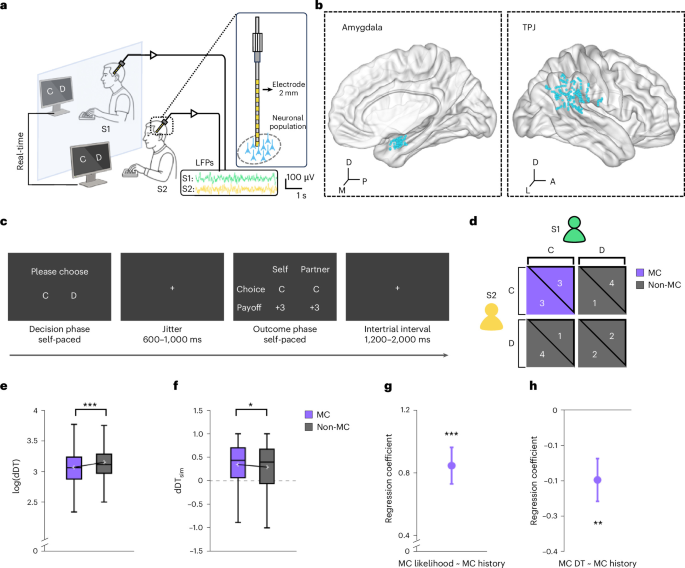
Mutual cooperation (MC) requires independent decision-makers to coordinate under uncertainty about each other’s intentions. Using simultaneous intracranial electroencephalography from epilepsy–patient dyads playing a real-time iterated prisoner’s dilemma, we identified neurocognitive mechanisms that enable interacting brains to align during mutual cooperation. Amygdala interbrain representational alignment (IBRA), similarity in fine-grained neural spectral patterns across partners, emerged selectively during MC and predicted trial-by-trial outcomes.
Early θ-suppression-characterized IBRA reflected rapid, history-sensitive alignment, whereas later IBRA, characterized by low-frequency suppression and γ increases, supported coordinated commitment and action. Furthermore, mutual cooperation relied on an amygdala-mediated, simulation-to-decision cascade, operationalized here as a model-based prospective estimate of partner cooperation that guided self-choice. Amygdala low-frequency suppression tracked this prospective estimate of partner cooperation and θ–γ coupling linked this partner estimate to self-decision processes.
Conditional cooperators strategically relied on partner tracking, whereas unconditional cooperators leveraged dispositional tolerance of uncertainty to transition into anticipatory neural alignment. These findings reveal the neural interdependency underpinning MC, redefining cooperation not as isolated decision-making but as a dynamic, interbrain, cognitive alignment. This is a preview of subscription content, access via your institution Access Nature and 54 other Nature Portfolio journals Get Nature+, our best-value online-access subscription Receive 12 print issues and online access Prices may be subject to local taxes which are calculated during checkout The raw magnetic resonance imaging and iEEG data that contain patients’ personal information are protected and have restricted access for ethical and privacy reasons.
Access can be obtained from the corresponding author upon reasonable request. Preprocessed data used to generate the figures and perform statistical tests are available in the following repository: https://osf.io/gy829. Analysis codes are available in the following repository: https://osf.io/gy829.
A cooperative species: human reciprocity and its evolution. (Princeton Univ. Why We Cooperate (MIT, 2009). Simultaneous intracranial recordings of interacting brains reveal neurocognitive dynamics of human cooperation.
Neurosci. 28, 161–173 (2025). Balliet, D. & Lindström, B. Inferences about interdependence shape cooperation.
Extract — continue reading at the source.