
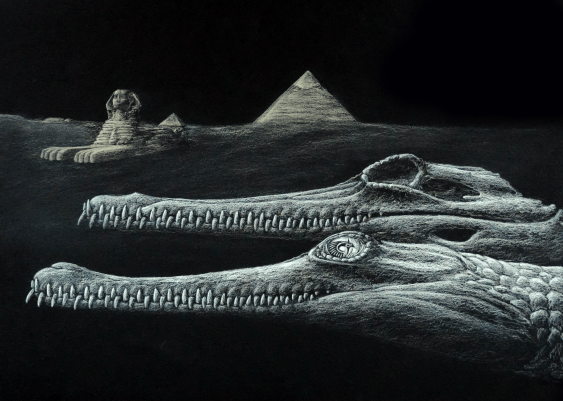
The Great Sphinx of Giza isn’t the only ancient, stony visage in the area missing its nose. A fossil crocodilian discovered in the same 45-million-year-old limestone that ancient Egyptians used to build the Sphinx is also missing the tip of its snout. But the broken specimen is intact enough to be reclassified as a new branch of the gavial family tree, which may help uncover these mysterious animals’ evolutionary history, researchers report October 7 in Royal Society Open Science.
Most living crocodilians are in either the crocodile or alligator families. But there are also two species of gavial living in tropical Asia. These are huge, critically endangered, fish-eating crocodilians with long, slender snouts full of needlelike teeth.
Fossils of extinct gavials have been found around the world. In 1927, German researchers reported a gavial skull fossil collected from hills near Cairo. The fossil was identified as an extinct species of Tomistoma, a genus found today only as a single species in Southeast Asia.
But more recent evolutionary studies including this fossil suggested this classification didn’t fit. In 2023, while working on a doctoral degree at University College London, paleontologist Paul Burke went to Germany to study the fossil in detail. Burke and his colleagues made careful measurements of the skull, using 3-D X-ray methods to measure the insides of the brain and nasal cavities.
The team compared the measurements to those taken of living and fossil gavials and found that this purported Egyptian Tomistoma was actually an undescribed gavial genus. The researchers named it Herugavialis cairensis, referencing the Egyptian god Heru (or Horus), who has been associated with the Great Sphinx. Coincidentally, the Herugavialis skull is missing the end of its snout — something it shares with the noseless statue.
But tens of millions of years ago, the reptiles also inhabited nearshore saltwater environments. Herugavialis appears to have been a coastal predator back when the ancient Tethys Ocean covered northern Egypt. Khalafallah Salih, a paleontologist at Al Neelain University in Khartoum, Sudan, says the finding supports the idea that the evolution of gavials and their relatives in Africa was much more complex than researchers thought.
Extract — continue reading at the source.

/https://tf-cmsv2-smithsonianmag-media.s3.amazonaws.com/filer_public/d6/3a/d63ab0e1-1057-4fce-8f8c-c0ea8bb2ea6e/a_1-fused-groups-of-anglo-saxon-coins-found-in-recent-excavati-95fcea8df7df53c8c8b6485cc9f1e443.jpg)

/https://tf-cmsv2-smithsonianmag-media.s3.amazonaws.com/filer_public/85/15/8515bbd0-d5ea-4316-9fa1-7358e578f9dd/nobel-physics.jpg)