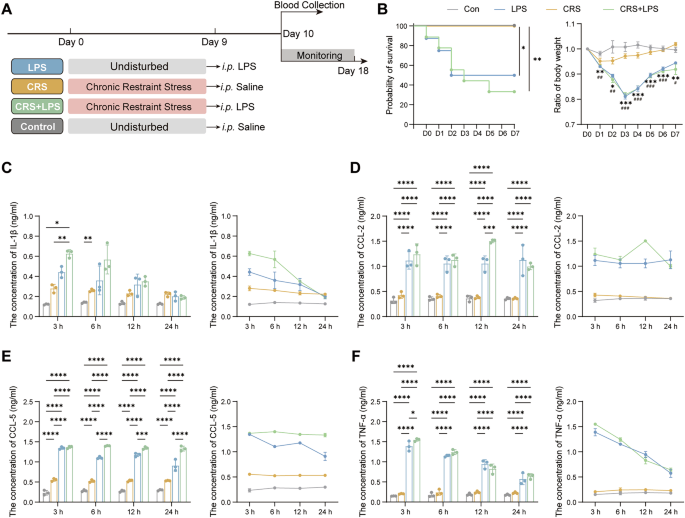
Chronic psychological stress is a major predisposing factor that worsens sepsis outcomes, yet the neural mechanisms linking stress exposure to immune dysregulation remain poorly understood. Here, using a mouse model of chronic restraint stress (CRS) followed by endotoxemia, we show that prior stress markedly aggravates mortality, systemic inflammation, and immune imbalance during sepsis. Mechanistically, we identify a stress-sensitive medial prefrontal cortex (mPFC)–dorsal motor nucleus of the vagus (DMV) circuit that functions as a central regulator of peripheral neuroimmune homeostasis.
Chronic stress is associated with impaired mPFC–DMV circuit function, accompanied by reduced splenic nerve activity, disrupted splenic norepinephrine (NE) and acetylcholine (ACh) signaling, heightened inflammatory responses, and diminished regulatory T cell (Treg) activity. Chemogenetic activation of the mPFC-to-DMV pathway restores splenic autonomic output, normalizes neurotransmitter homeostasis, attenuates systemic inflammation, improves survival, and rescues stress-associated Treg dysfunction. Importantly, chemical sympathectomy with 6-hydroxydopamine (6-OHDA) largely attenuates the protective effects of circuit activation, including its regulation of splenic NE/ACh balance, inflammatory cytokine production, and Treg responses, indicating that intact splenic sympathetic neuroimmune signaling is required for mPFC–DMV-mediated immunomodulation.
Furthermore, in vitro experiments reveal that exogenous ACh promotes macrophage-mediated Treg activation through α7 nicotinic acetylcholine receptors (α7nAChRs), providing a cellular mechanism through which autonomic neurotransmitter signaling regulates peripheral immune homeostasis. Together, these findings define a functional cortical–autonomic–immune axis through which chronic stress disrupts neuroimmune homeostasis during sepsis. Our findings further identify autonomic neurotransmitter signaling and α7nAChR-dependent macrophage–Treg communication as key mechanisms linking cortical circuit dysfunction to peripheral immune dysregulation, highlighting cortical-autonomic neuromodulation as a potential therapeutic strategy for stress-associated immune dysfunction in sepsis.
This is a preview of subscription content, access via your institution Receive 12 print issues and online access Prices may be subject to local taxes which are calculated during checkout The data supporting the findings of this study are available within the article and its Supplementary Information. Ben-Shaanan TL, Azulay-Debby H, Dubovik T, Starosvetsky E, Korin B, Schiller M, et al. Activation of the reward system boosts innate and adaptive immunity.
Yin L, Zhang J, Ma H, Zhang X, Fan Z, Yang Y, et al. Selective activation of cholinergic neurotransmission from the medial septal nucleus to hippocampal pyramidal neurones improves sepsis-induced cognitive deficits in mice. Br J Anaesth. 2023;130:573–84.
Zhai Q, Lai D, Cui P, Zhou R, Chen Q, Hou J, et al. Selective activation of basal forebrain cholinergic neurons attenuates polymicrobial sepsis-induced inflammation via the cholinergic anti-inflammatory pathway. Crit Care Med. 2017;45:e1075–e1082.
Extract — continue reading at the source.


