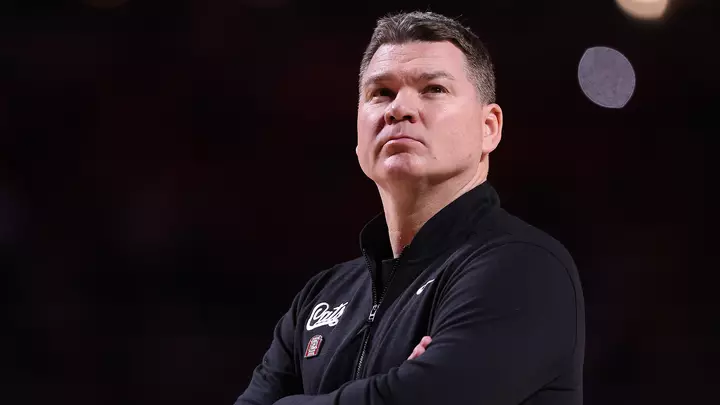
KANSAS CITY, Mo. -- When I sat down with Tommy Lloyd this week here inside the T-Mobile Center during what amounted to the second half of Big 12 Media Days, I expected to talk to the Arizona coach about everything from his rejection of North Carolina to the additions of Caleb Holt and Cameron Holmes. I figured Ivan Kharchenkov might come up. Perhaps even Bryce James.
The former Vanderbilt quarterback/future UFL player was nowhere in my notes. But Lloyd is coming off of a Final Four, in charge of one of college basketball's biggest brands, and an obviously smart guy. So before I was done with our conversation about his program and team, I wanted to get his thoughts about A) Kansas recently, and controversially, enrolling a 24-year-old who was the 59th pick in June's NBA Draft (Trey Kaufman-Renn), B) the NCAA relentlessly challenging five-year-eligibility-period cases connected to 2022 high school graduates, and C) everything else taking up so much oxygen in the sport of college basketball these days.
"My stance on the 5-for-5 is very clear," Lloyd began. "If you're a true 5-for-5 [case], and if the same situation were next year, and you could be eligible without a waiver, you shouldn't be ineligible now. [But] if you're in your sixth or seventh year [of college], and if you've got a story and a bunch of extenuating circumstances, yeah, I'm not too sympathetic to that. So I think what's frustrating for me is [that] when you kind of take a step back and you think about all of the conversations that go on behind the scenes, and, you know, we could go through a few of them here ..." "The Pavia Case" is where he picked up before explaining the different ways in which the NCAA is handling things now compared to how it handled them just two years ago when Pavia sued the governing body while arguing that its rules counting his junior college seasons against his Division I eligibility violated the Sherman Antitrust Act by improperly limiting his career and ability to earn name, image, and likeness income potentially worth millions of dollars.
His college football career continued thanks to an injunction. Not long after it was granted, the NCAA Division I Board of Directors approved a blanket waiver granting an extra year of eligibility for the 2025-26 academic year to former JUCO and non-NCAA school transfers who were in a position similar to Pavia's. "[After the Pavia case], the NCAA ... released a memo to the schools that [more or less said], 'based on this single ruling, we see it can create an uneven playing field among our competitive schools, so we are going to issue a blanket waiver for any kid that's basically in the same circumstances that Pavia was in.' And they did a blanket waiver." Why isn't the NCAA issuing a blanket waiver now, considering there are men set to play college basketball in less than two weeks only because they received injunctions from local judges just like Pavia once did?
Why isn't the NCAA issuing a blanket waiver now while acknowledging that not doing so would create an unequal playing field based on which players get injunctions and which don't, given that the NCAA did exactly that two years ago after acknowledging that not doing so would, yes, create an unequal playing field based on which players get injunctions and which don't? Those seem like totally reasonable questions. I asked Lloyd if he had an answer to them/theory about them.
"I think I do," he answered. "I think my theory is this thing has gotten so political -- and, obviously, there are a lot of things that need to be fixed in college sports," Lloyd said. "So [in my opinion,] the NCAA doesn't mind the 'chaos' right now because it can help drive the case for them to promote the [Protect] College Sports Act, which I'm sure we need." (Translation: The NCAA desperately wants the PCSA to pass ASAP, and it's easier to make the case to the public that college sports needs saving when there are stories weekly about players being ruled eligible and ineligible by local judges for reasons that are inconsistent, confusing and often biased.
Extract — continue reading at the source.