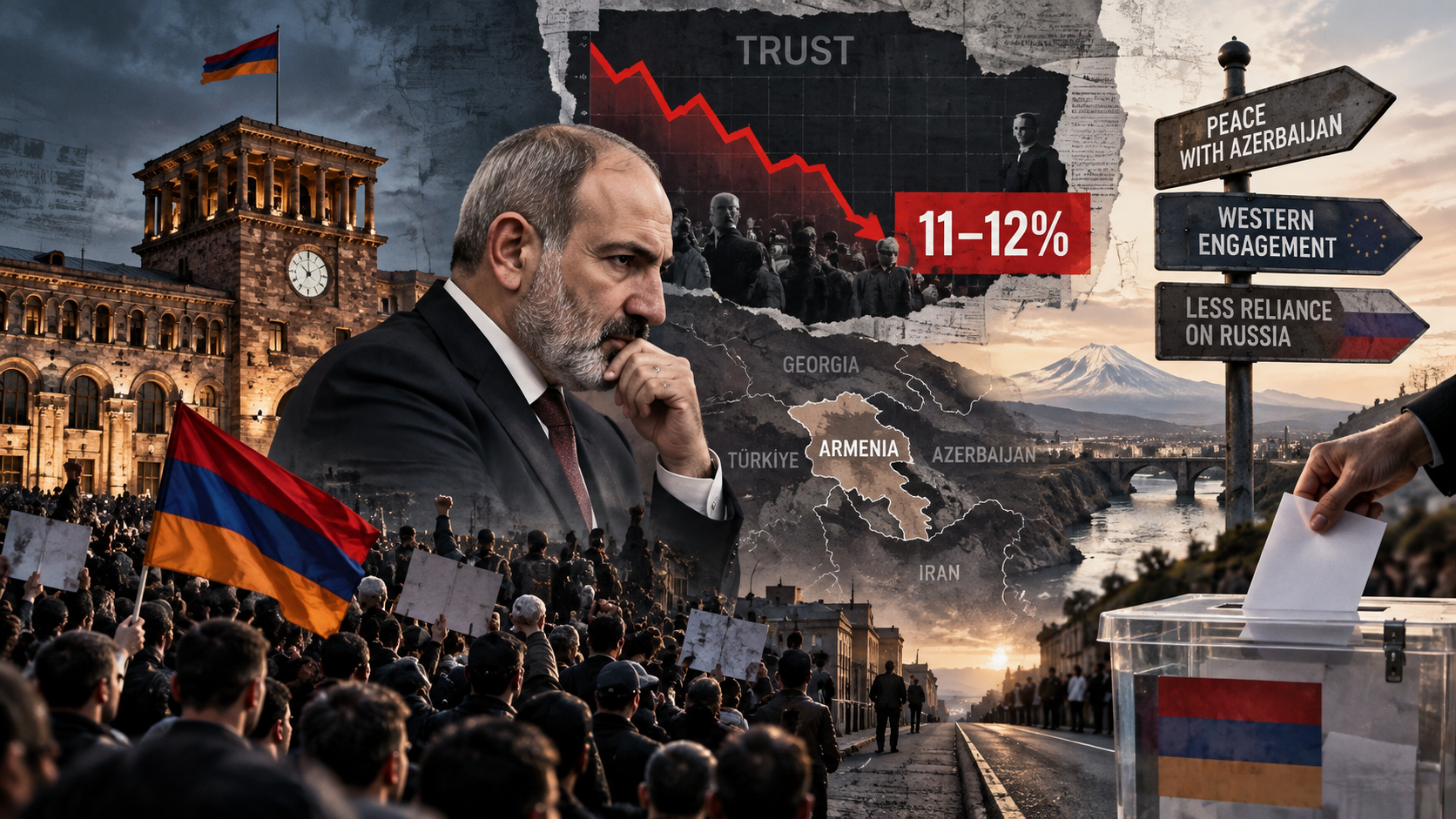
At an academic conference on South Caucasus transport and logistics last week, Gevorg Poghosyan, an economist at Armenia's National Academy of Sciences, said something that should have made more headlines than it did: trust in Armenia's current government has fallen to somewhere between 11% and 12%. Perhaps this isn’t the kind of figure a democracy brings along into a period of reorientation in its foreign policy. "Public anxiety in Armenia is increasing, and statements from members of the ruling team regarding the threat of a new war are only heightening tensions and eroding public trust in state institutions.
Additionally, the absence of a clear program for internal reforms and a lack of explanations regarding the objectives of changes in foreign policy and geopolitical direction raise the risk of further radicalization of public sentiment." This observation was made by Gevorg Poghosyan, an academician at the National Academy of Sciences of Armenia, during his speech at the international expert conference titled "Prospects for the Development of Transport and Logistics Relations in the South Caucasus." Mr Poghosyan's diagnosis is worth taking seriously precisely because it is not a hostile one. His complaint is not that Nikol Pashinyan's government is negotiating peace with Azerbaijan; he is largely sympathetic to the direction of the idea itself. His complaint is that Yerevan keeps explaining the process to its own public almost entirely through the language of threat.
Hand over Tigranashen or risk war, amend the constitution or risk war. Poghosyan notes, pointedly, that this framing appears more often in statements from Armenian officials than from Baku itself, an odd rhetorical choice for a government that insists it is building peace rather than merely avoiding catastrophe. This is the real issue, as the academician puts it, one of sequencing.
There is a true reorientation taking place in Armenia, that is a reorientation away from automatic Russian reliance towards an uncertain engagement with the West, and negotiations with Azerbaijan. All of these issues affect the nature of Armenian national identity, the involvement of the Armenian diaspora, and the place of the Armenian Apostolic Church in public affairs. None of these is trivial.
But, according to Mr Poghosyan, the public has been offered scant information regarding the end point, the duration of the process, or even the intermediary steps. Where are things heading? Is there a roadmap?" are, in his telling, questions the government has left largely unanswered.
Experience in other countries on this front leaves no doubt – efforts to push ahead with reform programs without winning popular consent often backfire when such patience is needed most. As all stated, it would also be a mistake to accept this account uncritically. Nikol Pashinyan's defenders have a reasonable rebuttal as well; he does actually speak often and directly to the Armenian people, explaining what he does well before he does it; and his party’s recent success at the ballot box indicates that the strategy hasn’t been a total failure.
Extract — continue reading at the source.