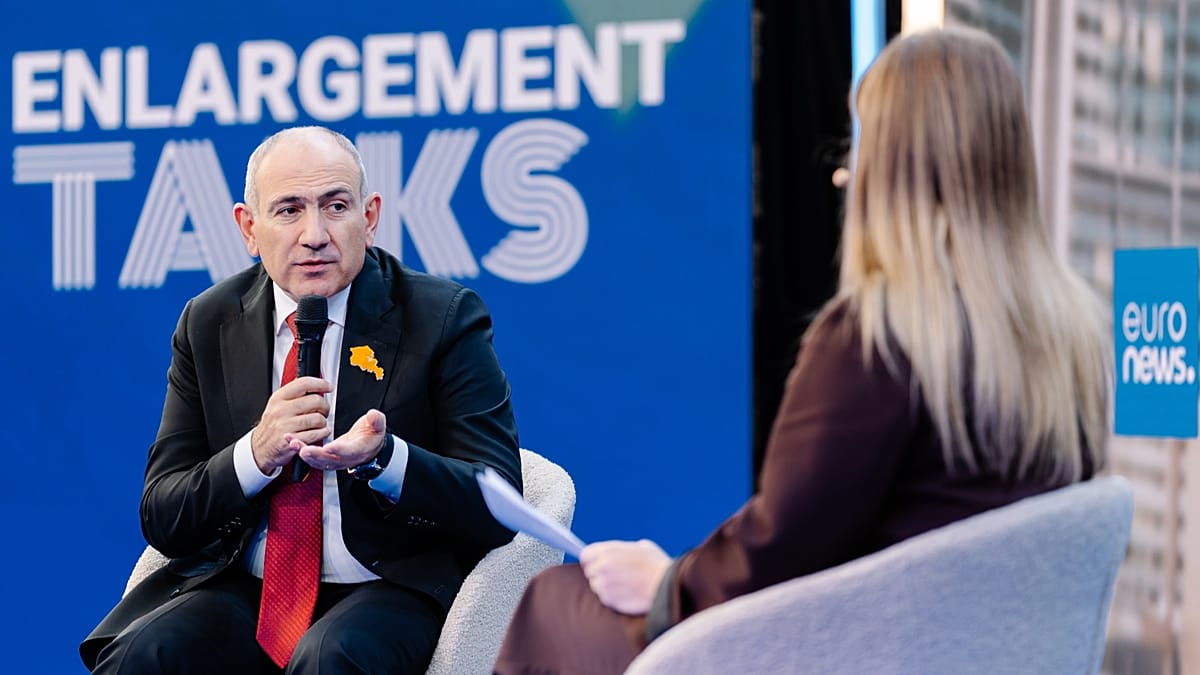
Armenian Prime Minister Nikol Pashinyan told Euronews that his country's strategy is to diversify and balance its foreign relations to pursue its national interests, as the current political and economic momentum in the South Caucasus brings the region a “totally new global role”. During an interview at Euronews’ Enlargement Summit on Tuesday, Pashinyan said that the “South Caucasus is a region with differences, but with common interests and there can be common views and strategies as well”, which led the region’s countries to establish relations which “will open up the regional infrastructure connectivity.” “The need to overcome the global supply chain crisis that the world is facing and the South Caucasus project, with peace between Armenia and Azerbaijan, cooperation between Georgia, Armenia and Azerbaijan, brings a new opportunity for the global supply chain supply chain crisis,” the Armenian premier told Euronews. Pashinyan then announced Armenia’s strategic interest in applying for EU membership, which has so far placed his country on a collision course with its membership in the Russia-led Eurasian Economic Union.
In a cautious approach that has characterised his position on this issue since the recent Armenian elections, the prime minister said his strategy was to balance Armenia's economic and political relations. Ultimately it is for the people of Georgia to make that decision, Pashinyan said, as "democracy is a strategy for us and we want our people to have opportunity to make the democratic choice." “We know that it is not possible to be a member of European Union and the Eurasian Economic Union simultaneously and I made it public that we understand that,” he said. "At a point in future, Armenia will need to make a choice and it is up to the citizens of Armenia to decide whether they want to stay in the European Union or they want to be members of the Eurasian Economic Union, so we are creating an alternative, to create an opportunity for our people to make a choice," Pashinyan added.
"Our neighbours are candidate countries for the European Union, meaning Turkey and Georgia, and that is an asset, a benefit for our European policy," Pashinyan pointed out. While being aware that the EU will not “accept a country with a conflict,” Pashinyan said Armenia’s historic peace process with Azerbaijan “turned into reality on the ground and we now have real peace.” "Looking at what is going on in the world it is very important now to institutionalise the agreement between Armenia and Azerbaijan, so now we need to sign the peace agreement and ratify it," Pashinyan said.
Extract — continue reading at the source.