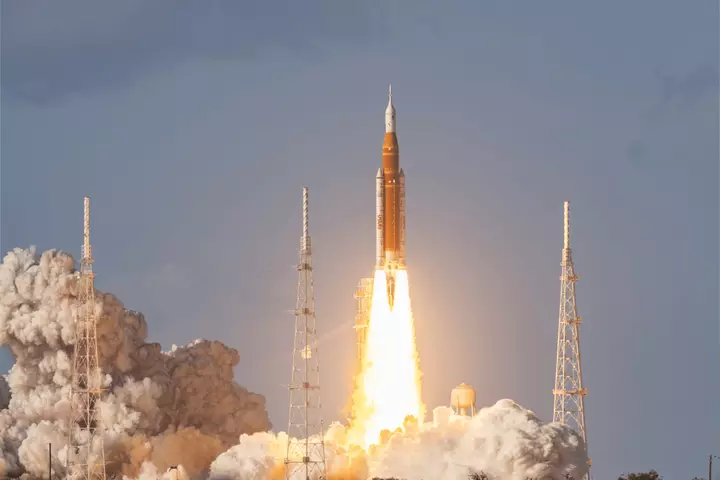
NASA's Artemis II mission in April 2026 created unusually large disturbances in Earth's upper atmosphere during its historic journey around the Moon, which researchers say could affect the accuracy of precision technologies such as GPS, drones, and self-driving cars. The findings raise questions about the potential impact on GPS and other navigation technologies in the future as increasingly powerful rocket launches become more frequent. The mission launched from Florida on April 1 aboard NASA's Space Launch System rocket, carrying astronauts Reid Wiseman, Victor Glover, Christina Koch and Jeremy Hansen.
The nine-day flight was the first time in more than 50 years that astronauts had traveled around the Moon. In a pre-print study published in July in Geophysical Research Letters, researchers, including corresponding author Charles C. Lin, found that the launch and later rocket exhaust burns caused three separate disturbances: one during lift-off, another about two hours later, and a third over 24 hours later.
The disturbances occurred in the ionosphere, a region of Earth's upper atmosphere through which GPS signals travel. Changes in this region can often affect the speed of GPS signals and, therefore, positioning accuracy. The initial launch sent waves through the upper atmosphere.
But researchers found some of the largest changes happened later, when the spacecraft fired its engines while already high above Earth. The engine burn about two hours after launch produced shock waves and what the researchers described as “unprecedented large-scale disturbances.” The other engine burn, about 25 hours after launch, created a similar, but weaker, effect. Artemis II didn’t physically punch a hole in the atmosphere.
Its exhaust caused a temporary drop in the concentration of charged particles in part of the ionosphere, creating what scientists call an “ionosphere hole,” which can temporarily affect technologies that rely on signals (like GPS) traveling through the ionosphere. The largest disturbance stretched across about 50 degrees of longitude (equivalent to roughly 2,500 miles at typical U.S. latitudes) over North America, according to the researchers. But the size of the "hole" wasn’t the only unusual feature.
Researchers said Artemis II was the first single space mission known to have produced three separate ionospheric disturbances over the same region during a series of maneuvers. While researchers found changes in the part of the atmosphere that can affect GPS accuracy, they didn’t report a widespread GPS outage caused by the mission. GPS works by using signals sent from satellites in space to receivers on Earth.
Extract — continue reading at the source.