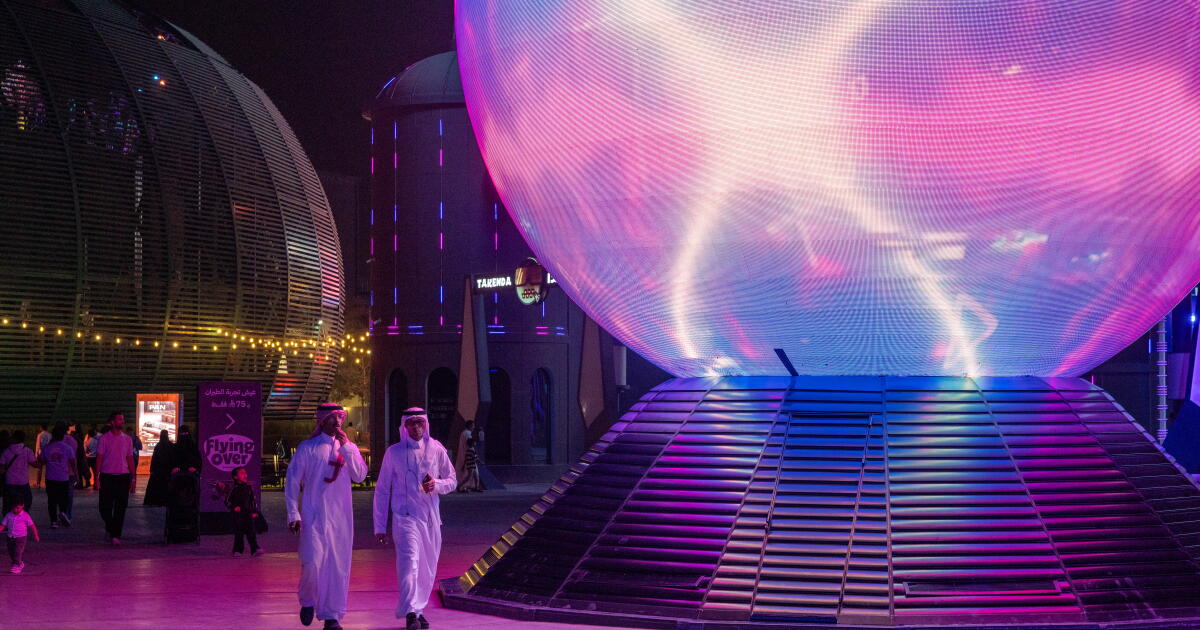
RIYADH, Saudi Arabia — The lineup was announced months ago, with top-flight stars in tennis, DJing, comedy and more set to descend on the Saudi capital for a 10-week run of events known as Riyadh Season. But after successive missile strikes hit Riyadh’s airport this month, killing more than a dozen people, shuttering parts of the country’s airspace and setting off a flurry of cancellations, many wondered if audiences would show up, or if there would be anything to show up for at all. The answer to both questions came this past weekend, when crowds gathered for Riyadh Season’s opener at Boulevard City, a car-free district in the capital that’s part open-air mall, part amusement park and part entertainment venue.
By the time sunset had turned to dusk, families were milling about a replica of Times Square. Patrons assembled for a sold-out comedy play at one of two theaters, while others went to a 7,000-seat arena, where a famous Lebanese pop star was debuting his comeback tour. This is a twilight moment for the Saudi capital.
In normal times, October is when the convection-bake temperatures of Riyadh’s ferocious summer give way to a bearable, even pleasant heat, and the city hosts dozens of large-scale events aimed at showcasing Vision 2030, the kingdom’s all-out drive to transform itself into a sporting and entertainment powerhouse. But between the U.S.-Israeli war on Iran and Riyadh’s escalating grudge match with the Iran-backed Yemeni rebels known as the Houthis, these are hardly normal times. For years, the war with the Houthis — whose official name is Ansar Allah, or Partisans of God — had ebbed and flowed between campaign and ceasefire, but for most Saudis, it had remained background noise.
That changed in recent months, with a truce breaking down, and the Houthis lobbing drones, ballistic and cruise missiles across Saudi Arabia. All of a sudden, the war took on a more present form, unsettling a kingdom unused to conflicts playing out on home turf. Almost every night in Riyadh brings the bass-drum booms and thuds of interceptors launching to destroy incoming projectiles.
Government messaging has turned pugilistic, replacing paeans to Vision 2030 and the country’s leadership with images of Saudi F-15s en route to do battle over Yemen, or commercial billboards declaring “Our bravery brings us together” or “Stable home, reassured hearts.” In October alone, Houthi missile strikes on Saudi airports have killed at least 21 people and wounded hundreds, forcing authorities to shut down operations in the country’s main international airport in Riyadh and curtailing travel in others. (On Sunday, officials announced some flights at the Riyadh airport had resumed.) Schools shifted to online-only learning, while many businesses — including Saudi Aramco, the country’s state-owned oil company — were ordered to evacuate headquarters and have all staff work remotely. Embassy ordered “non-emergency U.S. government employees and their family members” in Saudi Arabia to leave. The attacks come at an inopportune juncture.
Many of the kingdom’s marquee, international-facing gatherings have been affected, including the World Petroleum Congress, a summit between the European Union and Persian Gulf nations, and the government’s flagship investment conference, the Future Investment Initiative. Though the congress went ahead — with many top oil executives attending virtually — the summit and investment conference were shelved till next year. Also postponed were some of Riyadh Season’s major sporting events, such as the Six Kings Slam tennis tournament.
Extract — continue reading at the source.