The EU and several Southeast Asian nations are nearing the finish line on bilateral trade deals, and if the current deadlines hold, the European bloc will have agreements in place with six out of 11 ASEAN states by the middle of next year. Free trade agreements with Singapore and Vietnam are already in force. Negotiations with Indonesia have concluded, and Jakarta aims to sign the agreement in October, with implementation targeted for early 2027.
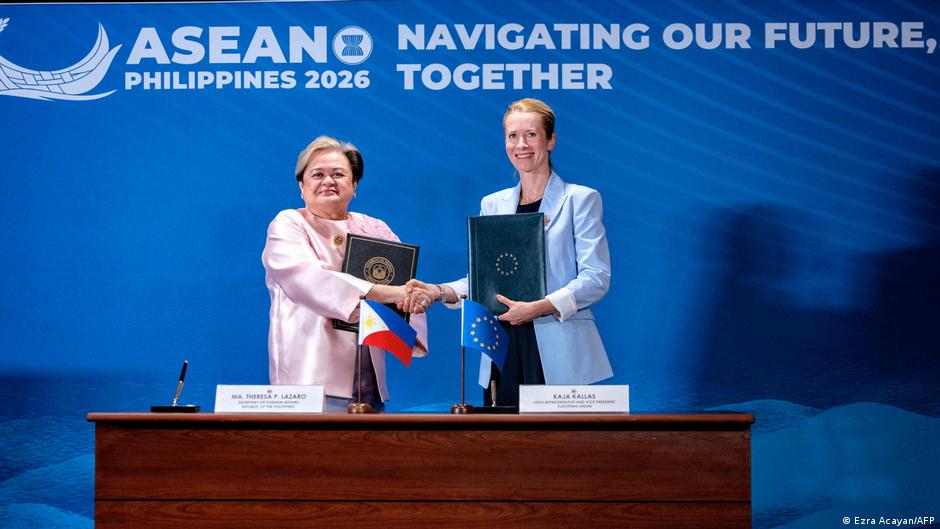
To view this video please enable JavaScript, and consider upgrading to a web browser that supports HTML5 video Talks with Thailand, relaunched in 2023, have reached nine negotiating rounds, while Malaysia resumed negotiations in early 2025 after a 13-year pause. Both are expected to be finalized by the end of the year or early 2027. Earlier this week, the EU and the Philippines announced that they had reached "substantial agreement" on their free trade agreement, putting it on course for formal conclusion in the coming months.
Speaking to DW, Chris Humphrey, executive director of the EU-ASEAN Business Council, described EU engagement with ASEAN on trade and investment issues as "at an all-time high." EU-Southeast Asia goods trade reached €274.9 billion ($313.7 billion) last year, up around 6% from the previous year and more than 50% from the €177.9 billion recorded in 2016, according to EU data. The Association of Southeast Asian Nations (ASEAN) is now the EU's third-largest goods trading partner outside Europe, behind only the United States and China. This week, Manila hosted both the ASEAN–EU Business Summit and the 22nd meeting of ASEAN economic ministers and the EU's trade commissioner.
The two blocs pledged greater cooperation to protect themselves from rising geopolitical tensions, including unilateral trade actions and regional conflicts, that "collectively threaten the rules-based international order." Brussels is expanding its network of trade agreements globally as it looks to expand to new markets and form more resilient supply chains. Southeast Asia, in turn, sits at the center of supply chains for semiconductors, electronics, electric vehicles and batteries, with investment pouring into data centers, renewable energy and digital services. An article published this month by the International Monetary Fund said ASEAN's 11 economies already form a $4.5 trillion bloc, growing at more than 4.5% a year.
Such economic expansion, combined with multinational firms' efforts to diversify production beyond China, has made access to Southeast Asian markets more attractive for European companies. Alfred Gerstl, an expert on Indo-Pacific international relations at the University of Vienna, told DW that geopolitical and geo-economic changes are also accelerating cooperation between the two regions. US President Donald Trump's "protectionist and erratic trade policies" have acted as a crucial catalyst, he said, while the EU's strategy of "de-risking from China" and diversifying supply chains boosted Southeast Asia's strategic importance.
A stronger partnership with European nations also plays in favor of Southeast Asia governments, who have long tried to maintain broad economic relationships with competing powers rather than becoming excessively dependent on China, the United States or any other single partner. The EU-ASEAN Business Council, said Humphrey, is calling for a region-to-region economic framework with a clear pathway to an eventual region-to-region free trade deal, "something European business has consistently called for." "This would adopt a modular approach, perhaps starting with a region-to-region Digital Trade Agreement and an Investment Protection Agreement," Humphrey told DW. The idea is not exactly new — the EU and ASEAN launched negotiations for a region-to-region agreement in 2007, but the talks bogged down over enormous differences between ASEAN economies and disagreements over the agreement's scope.
Extract — continue reading at the source.