This study compared the amplitude of resting-state low-frequency haemodynamic fluctuation over the prefrontal cortex between curling-trained and curling-naive young adults. Forty-two right-handed male undergraduates were included (21 trained, 21 controls). Functional near-infrared spectroscopy recorded 10 min of resting-state data across 22 prefrontal channels, of which the middle 8 min were analysed.
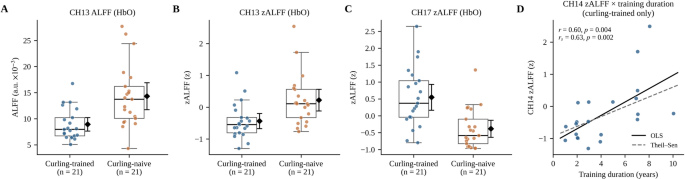
Using oxyhaemoglobin as the principal indicator, three amplitude indices were compared, the absolute (ALFF), within-participant standardised (zALFF) and fractional (fALFF) values, with Benjamini-Hochberg correction and mixed-design models for spatial structure. First, overall prefrontal ALFF was lower in the trained group with no Group x Channel interaction, and right frontopolar channel CH13 survived correction. Second, the Group x Channel interaction was significant on zALFF, with greater relative prominence at left dorsolateral channel CH17 and a borderline reduction at CH13; decomposition showed that this difference was carried by hemispheric balance rather than by differentiation among prefrontal regions.
Third, fALFF showed no group difference, and deoxyhaemoglobin effects were directionally consistent. Finally, an exploratory analysis found greater relative prominence at right ventrolateral CH14 among participants trained for seven or more years. Because the design is cross-sectional and no cognitive task was administered, these are associations and the functional labels are candidate interpretations.
The acquisition of sport skill depends on many hours of specialised practice. This process reshapes the musculoskeletal system and motor skill, and is accompanied by measurable structural and functional differences at the level of the central nervous system1,2,3,4. Characterising these differences helps clarify how the human brain supports skill learning, and may eventually contribute objective indicators for athlete assessment.
Much of this evidence comes from task-based paradigms and has been interpreted within the neural efficiency hypothesis, which attributes the lower or more selective task-evoked activation of skilled performers to a more economical allocation of neural resources5,6,7 task-based fMRI and EEG studies in shooting, golf and martial arts have accordingly reported activation differences between trained and untrained participants in prefrontal and motor cortex8,9,10. Because that hypothesis concerns task-evoked activation in performers whose training histories are far larger than those of the present sample, and because a resting-state amplitude comparison in a cross-sectional design cannot evaluate it, it is cited here as context for the literature and not as a framework this study tests. Task-based paradigms capture transient activation evoked by a particular task, and are less suited to characterising the more stable, trait-like properties associated with an extended training history11,12,13,14.
Resting-state measurement offers a complementary view. The amplitude of low-frequency fluctuation (ALFF) summarises the strength of spontaneous fluctuation in a region and has been widely used as an experience-related marker15,16,17. Two derived indices are commonly reported alongside it.
Extract — continue reading at the source.


