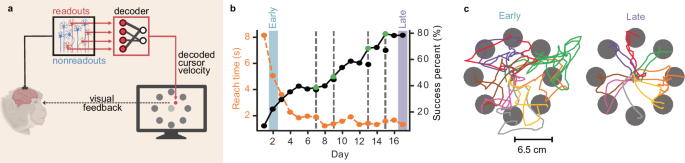
We investigated how task assistance influences learned neural representations using Brain-Computer Interfaces (BCIs), which map neural activity into movement via a decoder. We analyzed motor cortex activity as monkeys practiced BCI with a decoder that adapted to improve or maintain performance over days. Over time, task-relevant information became concentrated in fewer neurons, unlike with fixed decoders.
At the population level, task information also became largely confined to a few neural modes that accounted for a small fraction of the population variance. A neural network model suggests the adaptive decoders directly contribute to forming these more compact neural representations. Our findings suggest that assistive decoders manipulate error information used for long-term learning computations like credit assignment, which may explain the altered neural representations and inform real-world BCI design.
Motor learning has been defined as the process by which motor skills are acquired and maintained1. Learning depends on feedback error signals from multiple sources2 and in multiple forms3, which are corrected to improve task performance and refine movement4,5,6. These errors must be communicated to relevant neural circuits while accounting for the complex pathways linking neural activity to the motor workspace—a challenging credit assignment problem7.
In reaching tasks, error-related neural activity has been observed in the motor cortex and other regions8,9,10. Although the mechanisms by which such errors drive both widespread11 and highly localized12,13,14 neurophysiological changes remain incompletely understood, we expect them to manifest as changes in the neural representations of task-relevant information. Intracortical brain-computer interfaces (BCIs) provide a powerful framework to study how motor errors shape neural changes15,16.
BCIs define a mapping ("decoder”; Fig. 1a) between neural activity and movement17,18,19 to causally interrogate learning. Perturbations of well-learned BCI mappings, analogous to perturbations of natural movement20,21, have been used to probe the neural mechanisms of short-term adaptation by introducing task errors22,23. Alternately, novel BCI mappings learned over multiple practice sessions can be used to study neural mechanisms related to skill formation24,25,26,27.
BCI skill learning studies often use fixed decoders that provide limited performance, thereby placing substantial demands on neural adaptation to reduce task errors. In contrast, application-driven BCIs often use adaptive decoders, whose parameters are updated during use, to improve or maintain performance over time (Fig. 1a, b)19,28,29,30,31,32,33,34,35,36. These assistive interventions modify the mapping between neural activity and movement without introducing task errors (and potentially reducing them).
Extract — continue reading at the source.