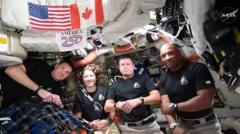
The Artemis II crew have safely returned home after re-entering Earth's atmosphere at 25,000mph (40,000km/h), splashing down off the coast of California. They have travelled deeper into space than any humans before them - just over 4,000 miles more than the record of 248,655 set by Apollo 13 in 1970. Astronauts are highly trained to cope with the physical and mental strain of space.
Although it might seem like it would be a difficult experience to endure, astronauts talk about being in space as the highlight of their lives and say they would return in an instant. In a press conference before landing, Christina Koch said the inconveniences, such as freeze-dried food or a toilet without much privacy, were worth it. Nasa does not release details about the crew members' health or private lives, but here's what's likely to happen to Reid Wiseman, Christina Koch, Victor Glover and Jeremy Hansen now they're back.
On arrival they will be immediately examined by doctors on the US warship sent to retrieve them. Then they will be flown ashore by helicopter before being taken by plane to Nasa's Johnson Space Center in Houston. Spending time in space will have been physically gruelling for the Artemis II crew.
Without the tug of gravity, muscle and bone mass shrinks in space. The most affected muscles are those that help maintain posture in the back, neck and calves. Speaking to BBC Newsnight ahead of the Artemis II splashdown in the Pacific, former UK astronaut Tim Peake said the gravity tug was "quite punishing".
"It will feel to begin with like a small push in your back but it will gradually build up," he said. "Anybody who has been on a rollercoaster ride, you may have experienced 4G but probably for less than a second, so when you feel it for minutes at a time it's quite punishing." Astronauts have strict exercise requirements but it can't stop all wastage. After just two weeks, muscle mass can fall by as much as 20%.
But remember, around 700 people have been into space before, including low Earth orbit. The time the Artemis II crew have spent up there will be amongst the shortest. During the space shuttle era in 1981 to 2011, astronauts spent two to three weeks in space.
Extract — continue reading at the source.


