This article has been reviewed according to Science X's editorial process and policies. Editors have highlighted the following attributes while ensuring the content's credibility: Cement manufacturing is one of the largest sources of CO₂ emissions in the construction industry. At the Department of Architecture, Karen Antorveza Paez, who has just completed her doctorate at ETH Zurich, is researching an alternative that works in a different way: instead of firing rocks at over 1,000°C, she is getting bacteria to bond grains of sand together into solid architectural elements.
"We're using bacteria to produce a sort of mineral glue," explains Antorveza Paez. When certain types of bacteria are combined with sand or other solid grains, they join the particles together into a solid structure made of interlocking, microscopic calcite crystals. The process is called microbiologically induced calcite precipitation (MICP), or simply biocementation.
It's nothing new: the bacteria used for this, Sporosarcina pasteurii, have been studied for many years, including for stabilizing loose subsoil. They have also been used in concrete research for "self-healing" concrete, where the introduction of bacterial spores causes cracks to seal over on their own. Antorveza Paez's innovation is how the process is controlled: not as an addition to existing building materials, but as an architectural material in its own right.
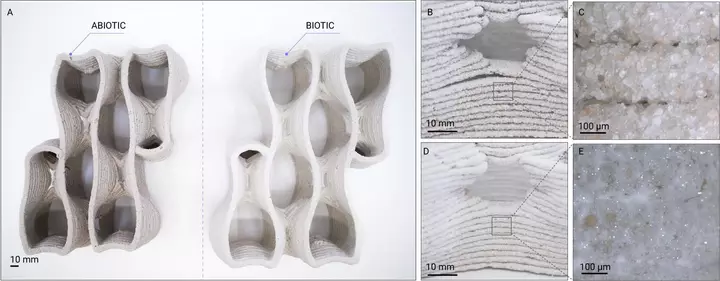
To achieve this, she combined two research fields that had until then been largely separate: biocementation and digital manufacturing. While it has long been known that bacteria can bond sand together into solid objects under certain conditions, Antorveza Paez explains, "What was missing were manufacturing processes whereby these biological processes can be controlled as required and used to make architectural elements." Three scientific studies—published in npj Materials Sustainability, Architectural Intelligence and Biotechnology Design and conducted during Antorveza Paez's doctoral work—describe two different manufacturing methods. For the first method, 3D biocement printing, the team developed a "bio-ink" made of a gel based on water and the natural substances alginate and xanthan, as well as sand and live bacteria.
As with a traditional 3D printing paste, the bio-ink can be printed into a desired structure. The printed object is then immersed in a bath containing urea and calcium chloride. This is where the bacteria start their work by breaking down the urea with an enzyme called urease.
This reaction releases carbonate ions and, as a byproduct, ammonium. The carbonate and calcium chloride in the solution bond together to form calcium carbonate, also known as limestone—the same mineral that makes up mussel shells and chalk. The limestone forms wherever the bacteria are located within the printed object.
Extract — continue reading at the source.


