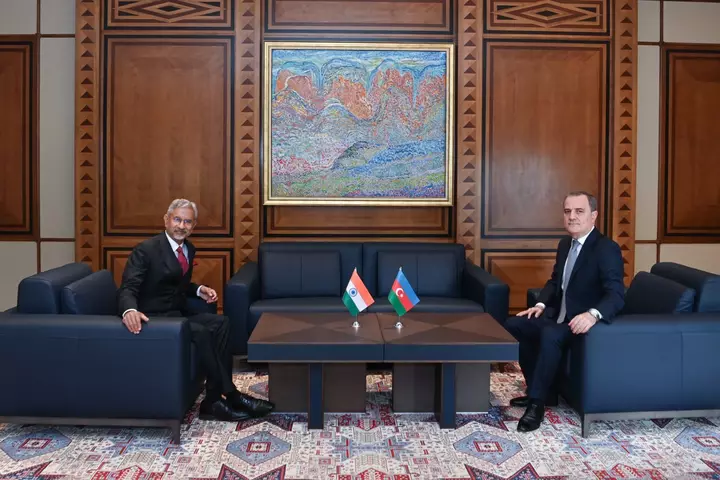
Diplomats prefer understatement, so Subrahmanyam Jaishankar's description of his visit to Baku on October 23rd as charting a "pathway" for relations deserves a second look. India's foreign minister had not come to Azerbaijan for eight years, nor did he arrive on a whim: he said Prime Minister Narendra Modi had sent him, following the first-ever meeting between Modi and President Ilham Aliyev on the sidelines of the Shanghai Cooperation Organisation summit in Bishkek on September 1st. After a year of strained ties, that is a significant reversal.
Historically speaking, over the past 20 years, the relationship between Delhi and Baku has fluctuated between hot and cold, with the cooling of relations having deeper roots. Officially, New Delhi stayed neutral on Karabakh, calling for restraint and backing the OSCE Minsk Group, but as the years passed, its sympathies tilted more towards Yerevan. In 2008, India voted against an Azerbaijani-sponsored UN General Assembly resolution demanding the withdrawal of Armenian forces.
Armenia also supported the Indian demand for a bilateral settlement of the Kashmir dispute and India’s application for permanent membership in the UN Security Council, while Azerbaijan’s close relations with Pakistan had always been considered irksome in Delhi. The ties between Armenia and India assumed a military nature following the war of 2020. The Armenian government purchased four Swathi counter-battery radars worth $40 million and then signed an agreement worth approximately $210 million for Pinaka rocket launchers, anti-tank rockets, and ammo in 2022.
Armenia was the first buyer of the Indian-made Akash air defence system, acquiring 15 pieces of this weapon for around $720 million. According to SIPRI, India accounted for 43% of the total volume of weapons imports by Armenia from 2022 to 2024, compared to 94% from Russia from 2011 to 2020. Baku criticized this cooperation.
Indian officials insist on its commercial character. The last occurrence regarding the relationship between the two countries saw a sharp decline in ties after the India-Pakistan conflict in May 2025. During this time, Baku criticized India's military operation and aligned itself with Pakistan’s position on Kashmir, a stance that ultimately cost it goodwill in New Delhi.
Now, both governments have reasons to move on. President Ilham Aliyev, who sees diversity in his foreign policy approach, was reaching out to every important power; India, with its billion-plus population, was the biggest one left. The meeting of Jaishankar with President Aliyev and the Foreign Minister, Jeyhun Bayramov, highlighted the shared ground between them.
Extract — continue reading at the source.